

Automate EAA Compliance in 10 Minutes
Accessibility, European Accessibility Act, WCAG 2.1 AA, Automation
10 Minutes to EAA Compliance That Would Take Manual Developers 60+ Hours
The European Accessibility Act is transforming accessibility from an aspirational goal into a binding legal obligation—yet most organizations still rely on slow, manual methods that cannot realistically scale. This article outlines how a modern, automated approach can compress 60+ hours of traditional WCAG 2.1 AA remediation into a 10‑minute deployment window, without compromising rigor, control, or user experience.
Why Manual Development Still Consumes 60+ Hours Per Website
For most organizations, accessibility compliance remains a developer‑heavy, ticket‑driven exercise. A typical remediation project for a mid‑sized website—several hundred templates, dynamic components, and third‑party scripts—requires at least 60 hours of specialist effort. That estimate is conservative once you factor in discovery, documentation, stakeholder reviews, and regression testing across multiple devices and assistive technologies. The result is a backlog of partially compliant properties, rising legal exposure, and frustrated teams who know they are always behind the curve.
The core challenge is structural. Manual remediation is linear and brittle—developers must identify every instance of non‑compliant code, apply fixes at the template or component level, and then retest whenever content, design, or functionality changes. In an environment where digital experiences are updated daily, this model simply cannot keep pace with the European Accessibility Act’s broad scope and the technical granularity of WCAG 2.1 AA standards.
The Growing Urgency of Digital Accessibility Compliance Under the EAA
The European Accessibility Act (EAA) represents one of the most comprehensive regulatory frameworks for digital accessibility introduced in recent years. Unlike earlier, narrower directives, the EAA extends obligations across a wide range of products and services—e‑commerce platforms, banking applications, transport services, media, and more. For organizations operating in or serving the EU market, accessibility compliance is no longer optional; it is a prerequisite for market access, risk management, and brand integrity.
Enforcement is tightening. Supervisory authorities are gaining clearer mandates, standardized methodologies, and growing political support to act on non‑compliance. Penalties can include administrative fines, corrective orders, and reputational damage triggered by public reports or consumer complaints. Critically, the EAA is technology‑neutral—it does not prescribe how you must achieve accessibility, only that you demonstrably meet the underlying functional requirements mapped to WCAG 2.1 AA. This creates an opportunity for automation, but also removes any safe harbor for organizations that delay action or rely on superficial fixes.
Breaking Down the 60+ Hour Manual Accessibility Burden
To understand the value of automation, it is useful to deconstruct where those 60+ hours of manual development actually go. While every organization’s stack is different, the pattern is remarkably consistent across sectors and technologies. A typical manual remediation program for a single website or application involves the following phases and activities:
Discovery and auditing (10–15 hours)—crawling templates, mapping user flows, running automated scans, and conducting manual keyboard and screen reader testing to identify gaps against WCAG 2.1 AA success criteria.
Remediation design (8–12 hours)—defining remediation patterns, updating design systems, and translating WCAG requirements into actionable UI and code guidelines for developers and content teams.
Development and refactoring (25–30 hours)—modifying templates, components, and scripts to address issues such as missing semantic landmarks, inaccessible forms, non‑compliant color contrast, and non‑keyboard‑operable controls.
Testing and validation (10–15 hours)—regression testing across browsers, devices, and assistive technologies; validating against WCAG 2.1 AA; and documenting outcomes for internal and regulatory reporting.
These activities are necessary, but the way they are executed is often inefficient. Each new campaign, landing page, or microsite restarts the cycle, consuming scarce specialist capacity. Moreover, code‑level changes are tightly coupled to specific frameworks and releases, which means accessibility improvements can be delayed by dependency conflicts, release freezes, or competing roadmap priorities. The result is a recurring 60+ hour tax on every significant digital property you operate.
The Hidden Costs of Manual Accessibility Implementation for Enterprises
The visible development hours are only part of the total cost. Manual accessibility implementation introduces a series of indirect, but material, impacts that many leadership teams underestimate. These hidden costs accumulate across the organization and erode the business case for relying solely on manual remediation, especially under the time pressure of the European Accessibility Act.
Opportunity cost of specialist resources—front‑end and UX engineers with accessibility expertise are frequently diverted from strategic product work to address legacy issues and compliance gaps, slowing innovation and time‑to‑market.
Fragmented governance—accessibility standards are implemented inconsistently across teams, brands, and regions, increasing the risk of non‑compliance and making it harder to demonstrate a coherent, organization‑wide accessibility posture to regulators and auditors.
Ongoing maintenance overhead—every design refresh, CMS migration, or framework upgrade risks reintroducing accessibility issues, forcing teams to repeat large parts of the remediation cycle and effectively “pay twice” for the same outcomes.
Reactive risk management—without continuous monitoring and automated enforcement, organizations often discover accessibility failures only after user complaints, audits, or legal challenges, when remediation is most expensive and reputational damage is already done.
In short, manual remediation scales linearly with complexity and change. As your digital footprint grows, so does the cost curve—often exponentially. Automation, by contrast, decouples compliance from individual codebases and releases, enabling you to achieve consistent accessibility compliance at a fraction of the time and operational risk.
Why WCAG 2.1 AA Standards Are Inherently Complex to Implement Manually
The Web Content Accessibility Guidelines (WCAG) 2.1 AA form the technical backbone for most modern accessibility regulations, including the European Accessibility Act. While WCAG provides clear, testable success criteria, translating those criteria into robust, maintainable code across a heterogeneous digital ecosystem is non‑trivial. The complexity arises from three interrelated dimensions—breadth, depth, and dynamism.
Breadth—WCAG 2.1 AA covers perceivability, operability, understandability, and robustness across a wide range of content types, interaction patterns, and user contexts. Achieving conformance requires coordinated changes to semantics, structure, presentation, and behavior, not just superficial adjustments to color or text alternatives.
Depth—many success criteria involve nuanced technical requirements that must be implemented precisely to work reliably with assistive technologies. Examples include ARIA roles and states, focus management in single‑page applications, keyboard interaction models, and error handling for complex forms and workflows.
Dynamism—modern interfaces are highly dynamic, with content rendered client‑side, components reused across contexts, and personalization driving different experiences for different users. Ensuring that all variants remain compliant as they evolve is extremely difficult without automated detection and remediation.
When teams attempt to address WCAG 2.1 AA purely through manual development, they often focus on a subset of issues surfaced by ad‑hoc scans or audits. This leaves gaps—particularly in keyboard navigation, dynamic content updates, and assistive technology support—that may not be visible in basic browser testing but are highly material for users with disabilities and for regulators assessing substantive compliance. Automation is not a shortcut around WCAG; it is a mechanism for operationalizing WCAG at scale, consistently, and in near real time.
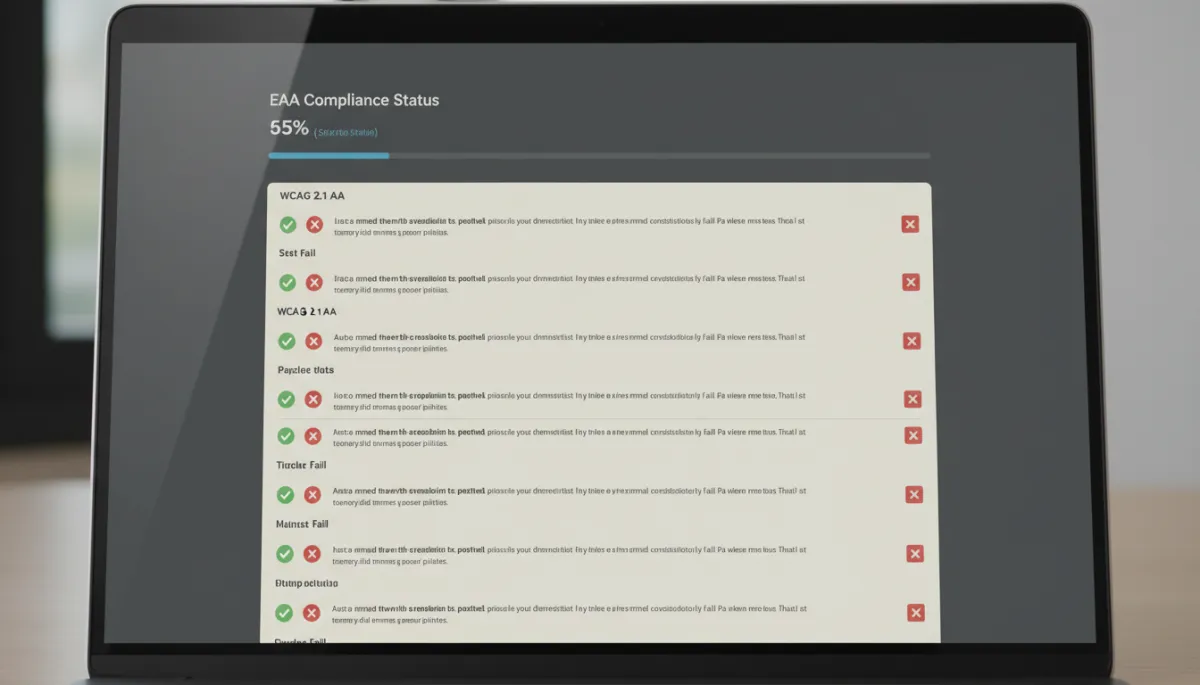
Automated audits surface WCAG 2.1 AA failures in minutes, not weeks of manual testing.
Introducing the 10‑Minute Solution: How Automation Transforms Accessibility Compliance
Against this backdrop of regulatory pressure and technical complexity, automated accessibility platforms provide a step‑change in how organizations achieve and maintain compliance. Instead of relying exclusively on code‑level remediation, automation layers a continuously updated accessibility engine on top of your existing digital properties—an engine that detects, interprets, and corrects many classes of issues in real time, aligned with WCAG 2.1 AA and the functional requirements of the European Accessibility Act.
Modern solutions leverage a combination of AI‑driven analysis, semantic understanding, and rules‑based transformations to modify the accessibility layer of your site without rewriting core templates. This enables you to:
Automatically generate and maintain alternative text, ARIA labels, and roles for many common interface elements and media assets.
Normalize keyboard focus order, skip links, and interaction patterns across pages and components, improving operability for keyboard‑only and assistive technology users.
Enforce color contrast and text scaling rules dynamically, ensuring perceivability even as content and branding assets evolve over time.
Provide end‑user personalization controls—such as font adjustments, spacing, and contrast modes—that enhance usability while supporting compliance obligations.
Crucially, these capabilities can be deployed in minutes—often via a single script or tag manager configuration—rather than through multi‑week development sprints. This does not eliminate the need for strategic accessibility governance or targeted manual fixes, but it dramatically reduces the baseline effort required to reach and sustain a high level of conformance across your portfolio.
The 10‑Minute Implementation Process: From Deployment to Verified Compliance
The promise of “10 minutes to compliance” is grounded in a streamlined, repeatable implementation process. While individual platforms differ, the operational pattern is consistent and designed to minimize disruption for development, security, and compliance teams. A typical 10‑minute deployment cycle includes the following stages:
Configuration and scoping—define which domains, subdomains, and applications will be covered; align configuration with your brand, languages, and regional compliance requirements under the EAA and related legislation.
Technical integration—deploy a lightweight script or tag via your preferred mechanism (tag manager, CMS plugin, or direct integration). This step typically requires no core code changes and can be tested in staging before production rollout.
Automated scanning and remediation—once active, the automation engine crawls your pages, identifies accessibility issues against WCAG 2.1 AA, and applies remediation at the accessibility layer, updating DOM attributes, focus management, and presentation as required.
Compliance reporting—dashboards and reports summarize your current accessibility posture, highlight residual manual issues, and provide documentation that supports EAA compliance evidence and internal risk reporting.
In practice, the bulk of the 10 minutes is spent on coordination—confirming scope, validating deployment in a test environment, and obtaining sign‑off from security or data protection stakeholders. The technical activation itself is near‑instantaneous. Once live, the system operates continuously, adapting to new content and design changes without requiring repeated development sprints or manual audits for every release cycle.
Comparing Real‑World Time and Resource Allocation: Automation vs. Manual Remediation
The strategic decision facing most organizations is not whether to pursue accessibility compliance—it is how to allocate resources between manual remediation and automated enforcement. When you quantify the difference in time, cost, and risk, the case for automation as a primary control becomes compelling, particularly for organizations with multiple brands, markets, or platforms to support under the European Accessibility Act.
Manual‑only approach—60+ hours of specialist development per property, recurring audits, fragmented documentation, and a continuous race to catch up with new content and feature releases. Suitable only for small, static sites or highly regulated components where manual code control is mandatory and changes are infrequent.
Automation‑first, manual‑supported approach—10 minutes to deploy an automated accessibility layer, followed by targeted manual remediation for edge cases, complex interactions, or bespoke components. Specialist resources focus on high‑value work, while automation handles the majority of repetitive compliance tasks at scale.
From a governance perspective, automation provides a consistent baseline—an always‑on safety net that significantly reduces the probability of critical accessibility failures. Manual work then becomes an optimization layer rather than a perpetual firefighting exercise. This hybrid model aligns closely with how other risk domains are managed, such as security and data privacy, where automated controls are complemented by targeted expert interventions and periodic independent assessments.
Beyond Time Savings: Strategic Benefits of Accessibility Automation
While compressing 60+ hours of manual development into a 10‑minute deployment is a powerful value proposition, the broader strategic benefits of accessibility automation are equally important for decision‑makers. Automation does more than accelerate remediation—it enhances governance, user experience, and organizational resilience in the face of evolving regulatory expectations under the European Accessibility Act and beyond.
Consistent, evidence‑based compliance—centralized dashboards, audit logs, and versioned reports provide a clear, defensible record of your accessibility posture over time, supporting regulatory inquiries, internal audits, and ESG reporting requirements.
Improved user experience for all customers—enhancements such as better focus states, clearer error messaging, and adjustable presentation benefit every user, not just those with disabilities, driving higher engagement, conversion, and retention metrics across key digital journeys.
Future‑proofing against regulatory change—as standards and interpretations evolve, automated platforms can update their rulesets and remediation logic centrally, propagating improvements across your properties without requiring individual codebase updates for every change in guidance or enforcement practice.
Reduced organizational risk—by continuously monitoring and correcting accessibility issues, automation lowers the likelihood of high‑impact incidents, complaints, or enforcement actions, shifting your posture from reactive compliance to proactive risk management.
Ultimately, accessibility automation is not simply a technical optimization. It is a strategic enabler that allows organizations to embed accessibility compliance into their operating model—treating it as an integral quality attribute of every digital experience rather than an after‑the‑fact checklist item addressed only when time permits or risk spikes.
Making the Smart Choice for European Accessibility Act Compliance
As the EAA enforcement horizon approaches, leadership teams must decide how they will operationalize accessibility compliance across their digital estates. Continuing to rely primarily on manual remediation, with its 60+ hour development cycles and high maintenance overhead, exposes organizations to avoidable risk and opportunity cost. An automation‑first strategy, by contrast, provides a rapid, scalable, and auditable path to compliance that aligns with modern expectations for digital governance and customer experience.
The most effective organizations are adopting a layered model. They deploy an automated accessibility engine to establish a consistent baseline aligned with WCAG 2.1 AA, then complement it with targeted manual interventions for complex, high‑risk, or highly customized interfaces. This approach balances speed with precision, ensuring that accessibility is both comprehensive and contextually appropriate, while keeping specialist resources focused where they add the most value.
📌 Key Takeaway: Automation is not a replacement for accessibility expertise—it is a force multiplier that enables experts to scale their impact across every property governed by the European Accessibility Act.
Take the First Step: Assess Your Current Accessibility Compliance Posture
The most efficient path to action begins with visibility. Before you can optimize your remediation strategy or justify an automation investment, you need a clear, data‑driven understanding of your current accessibility posture. A structured accessibility audit—ideally leveraging automated scanning aligned with WCAG 2.1 AA, supplemented by expert review of critical user journeys—provides this baseline and identifies where automation can deliver the greatest impact in the shortest time frame.
In practice, organizations that start with a focused audit are able to:
Quantify their current level of conformance against WCAG 2.1 AA and EAA‑relevant requirements, across key properties and user journeys.
Prioritize remediation efforts based on risk, business criticality, and user impact, rather than treating all issues as equal.
Build a robust business case for automation that reflects not only time savings, but also risk reduction, improved user experience, and enhanced regulatory resilience.
From there, implementing a 10‑minute automated solution becomes a straightforward operational step rather than a conceptual leap. With a clear understanding of your current gaps and priorities, you can configure automation to address the majority of issues immediately, then plan targeted manual enhancements where they are most needed—achieving measurable progress toward EAA compliance in days, not months.
