
Essential Digital Marketing Metrics for Beginners
Digital Marketing, Analytics, KPIs
The Beginner's Guide to Digital Marketing Metrics That Actually Matter
If you’re a business owner, you’ve probably heard terms like ROAS, CAC, LTV, and conversion rate thrown around in meetings and marketing reports. But knowing these acronyms isn’t enough. To make smart decisions, you need to understand what they mean, how they connect, and which ones truly matter for your bottom line. This guide breaks each metric down in plain language so you can confidently judge whether your marketing is working—or wasting money.
Why Most Business Owners Feel Lost in Marketing Metrics
Dashboards, reports, and agencies often bombard you with dozens of numbers—impressions, clicks, reach, engagement rate, view-throughs, and more. Many of these are vanity metrics: they look impressive but say very little about profit or growth. As a business owner, your priority is simple: are we making money from our marketing, and can we scale it safely?
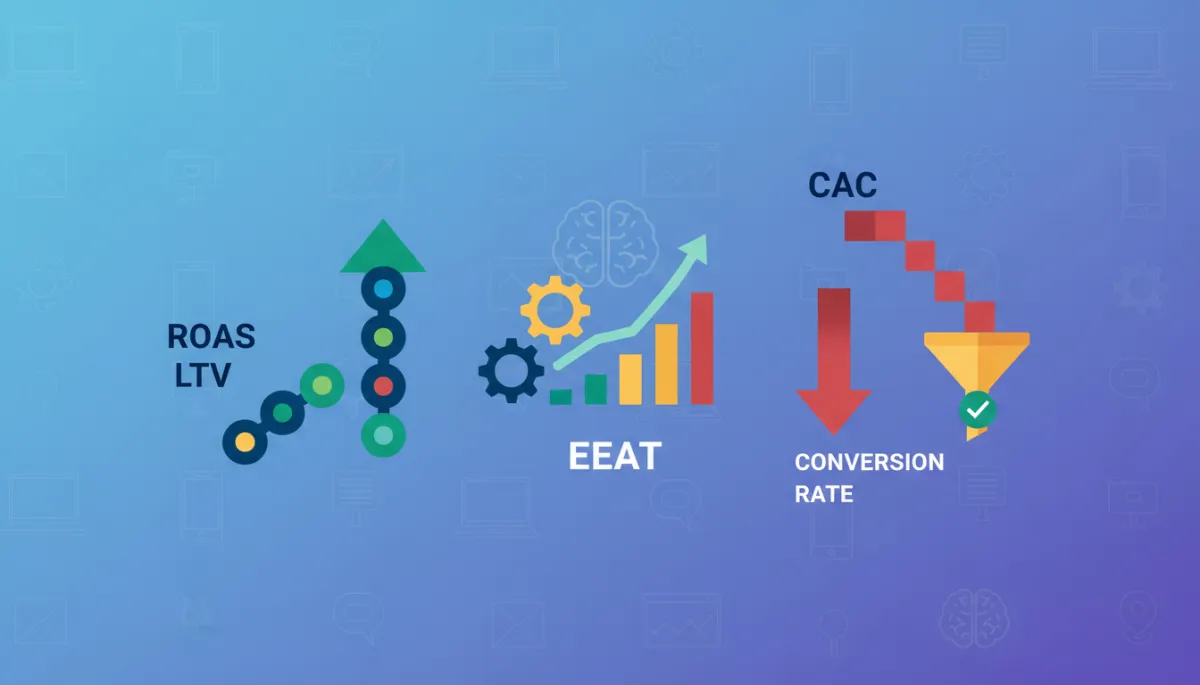
That’s where four core metrics come in: ROAS (Return on Ad Spend), CAC (Customer Acquisition Cost), LTV (Customer Lifetime Value), and conversion rate. When you understand these, you can cut through the noise, hold your team or agency accountable, and invest with confidence instead of guesswork.
📌 Key Takeaway: You don’t need 40 metrics. You need a small set of money-focused KPIs that tell you if your marketing is profitable and scalable.
The Four KPIs That Actually Matter for Most Businesses
ROAS (Return on Ad Spend): How much revenue you earn for every dollar spent on ads.
CAC (Customer Acquisition Cost): How much it costs you to acquire a new paying customer.
LTV (Customer Lifetime Value): How much total revenue an average customer brings in over the whole relationship with your business.
Conversion Rate: The percentage of people who take the action you want (buy, book a call, submit a form, etc.).
These four metrics form the backbone of a healthy marketing program. Let’s break each one down with simple formulas, examples, and practical tips so you can start using them immediately.
ROAS: Are Your Ads Actually Making Money?
What Is ROAS?
ROAS (Return on Ad Spend) measures how much revenue you generate for every dollar you spend on advertising. It is usually expressed as a ratio, like 4:1, or as a multiplier, like 4x. A ROAS of 4:1 means you earned four dollars in revenue for every one dollar spent on ads.
How to Calculate ROAS (Simple Formula)
The basic formula is:
ROAS = Revenue directly attributed to ads ÷ Ad spendExample: You spend $5,000 on Facebook and Google ads in a month, and those ads drive $20,000 in sales. Your ROAS is:
$20,000 ÷ $5,000 = 4
ROAS = 4:1 (or 4x)
What Is a “Good” ROAS?
There is no universal “good” ROAS because it depends on your profit margins and business model. However, a few guidelines help:
If your gross margin is high (for example, software or digital products), you can often afford a lower ROAS and still be profitable.
If your margin is low (for example, retail or food), you may need a higher ROAS to cover costs and make a profit.
💡 Pro Tip: Don’t judge ROAS in isolation. Always compare it to your margins and your CAC and LTV numbers to know whether you’re truly profitable.
How Business Owners Can Use ROAS Day-to-Day
Evaluate channels: Compare ROAS across platforms (Google, Meta, TikTok, email, etc.) to see where your money works hardest.
Decide what to scale: Increase budget on campaigns with strong ROAS and healthy margins; pause or fix underperforming ones.
Set targets with your team or agency: Agree on a minimum acceptable ROAS that still leaves room for profit.

A focused KPI dashboard helps leaders spot profitable and wasteful campaigns quickly.
CAC: How Much Does It Really Cost to Win a Customer?
What Is CAC?
CAC (Customer Acquisition Cost) tells you how much you spend, on average, to acquire one new paying customer. It is one of the most important numbers in your entire business because it shows how expensive growth really is. If your CAC is too high compared to your margins and LTV, you will struggle to scale without burning cash.
How to Calculate CAC (Simple Formula)
At its simplest, CAC is:
CAC = Total marketing and sales spend to acquire customers ÷ Number of new customersExample: In one quarter, you spend $60,000 on marketing and sales salaries, tools, and ad spend, and you acquire 300 new customers. Your CAC is:
$60,000 ÷ 300 = $200
CAC = $200 per new customer
What Should Be Included in CAC?
Paid advertising spend (search, social, display, etc.).
Agency fees and freelancers working on acquisition campaigns.
A portion of marketing and sales salaries tied to acquiring new customers.
Tools and software primarily used for acquisition (ad platforms, CRM, landing page tools).
📌 Key Takeaway: Be consistent. Even if you choose a slightly simplified CAC formula, calculate it the same way every month so trends are meaningful.
How Business Owners Can Use CAC
Budget planning: If your CAC is $200 and you want 500 new customers next quarter, you know you’ll need roughly $100,000 in acquisition budget (assuming similar performance).
Channel comparison: Compare CAC by channel (for example, Google Ads vs. referrals vs. organic search) to see where you acquire customers most efficiently.
Negotiating with agencies: Instead of only asking for more traffic or leads, demand improvements in CAC and quality of customers.
LTV: How Much Is a Customer Actually Worth Over Time?
What Is LTV?
LTV (Customer Lifetime Value) estimates the total revenue you can expect from an average customer over the entire relationship with your business. Instead of focusing only on the first purchase, LTV forces you to think about repeat purchases, subscriptions, upsells, and retention. It is crucial because your LTV sets the upper limit of what you can afford to spend to acquire a customer (your CAC).
A Simple Way to Estimate LTV
There are complex ways to model LTV, but most small and mid-sized businesses can start with a straightforward approach:
LTV ≈ Average order value × Average number of purchases per customerFor subscription businesses, a common shortcut is:
LTV ≈ Monthly revenue per customer × Average number of months they stayExample (e‑commerce): Your average order value is $80, and the typical customer makes 3 purchases over two years. Your LTV is:
$80 × 3 = $240
LTV = $240
Example (subscription): Your average customer pays $50 per month and stays for 18 months. Your LTV is:
$50 × 18 = $900
LTV = $900
Why LTV Matters So Much
Sets your acquisition ceiling: If your LTV is $240, you cannot sustainably spend $300 to acquire a customer—eventually, the math breaks, even if short-term ROAS looks good.
Explains why some competitors outbid you: If they have higher LTV (better retention, upsells, or pricing), they can afford a higher CAC and still profit, winning more ad auctions and attention.
Shifts focus from quick wins to relationships: Instead of only chasing first purchases, you start thinking about nurturing customers, improving onboarding, and building loyalty programs.
How Business Owners Can Increase LTV
Improve onboarding and customer experience so people stay longer and buy more often.
Launch complementary products or services that naturally lead to repeat purchases or upgrades.
Use email and remarketing to bring past customers back with relevant offers, not just discounts.
💡 Pro Tip: A common rule of thumb is to aim for an LTV:CAC ratio of at least 3:1. That means a customer is worth roughly three times what it costs to acquire them.
Conversion Rate: Turning Visitors into Buyers (or Leads)
What Is Conversion Rate?
Conversion rate is the percentage of people who take a specific action you care about—such as making a purchase, booking a consultation, requesting a quote, or signing up for a newsletter. You can have multiple conversion rates in your business (for example, website visitor to lead, lead to customer, ad click to purchase), but the idea is always the same: how many people move from one step to the next.
How to Calculate Conversion Rate
Conversion rate = (Number of conversions ÷ Number of visitors or leads) × 100%Example: 2,000 people visit your landing page in a month, and 80 of them purchase. Your conversion rate is:
(80 ÷ 2,000) × 100% = 4%
Conversion rate = 4%
Why Conversion Rate Matters So Much for Profitability
Higher conversion rates mean you get more customers from the same ad spend, which improves both ROAS and CAC.
Improving conversion rates is often cheaper than buying more traffic. Small changes to messaging, design, and offers can have big financial impact.
Strong conversion rates give you more room to bid aggressively on ads while staying profitable, helping you outcompete others in your space.
Simple Ways to Improve Conversion Rate
Make your offer and next step painfully clear—remove clutter and distractions from landing pages and key website pages.
Use social proof: testimonials, reviews, case studies, and trust badges reduce hesitation and increase confidence.
Reduce friction: simplify forms, offer guest checkout, and be transparent about pricing and shipping.
💡 Pro Tip: Track conversion rates at key stages—ad click to add-to-cart, add-to-cart to purchase, lead to booked call—so you can see where people drop off and fix the right step.
How ROAS, CAC, LTV, and Conversion Rate Work Together
Each of these metrics is powerful on its own, but the real insight comes from understanding how they connect. Think of them as parts of a simple profit equation:
Conversion rate affects how many customers you get from your traffic, which influences both ROAS and CAC.
ROAS tells you how much revenue your ad spend generates right now, but doesn’t automatically account for repeat purchases or long-term value.
CAC tells you how expensive it is to acquire a customer across all activities, not just ads.
LTV tells you how much that customer is worth over time, which determines how high your CAC can be while still making money.
A healthy business usually has:
A conversion rate that keeps CAC reasonable.
A ROAS that covers ad costs and contributes to profit, especially when viewed over the customer’s lifetime, not just the first sale.
An LTV that is at least three times higher than CAC, giving you room for overhead and profit.
📌 Key Takeaway: Don’t celebrate a high ROAS if your CAC is still too high compared to LTV. And don’t panic about a lower short-term ROAS if you know your LTV is strong and you’re building long-term value.
A Simple KPI Dashboard for Busy Business Owners
You don’t need a complicated analytics setup to start making better decisions. Even a simple monthly or weekly summary can give you clarity. At a minimum, ask your team or agency to report:
Total ad spend, total revenue from ads, and ROAS.
Number of new customers and your estimated CAC.
Updated estimate of LTV based on real customer behavior (average order value and repeat purchases or retention).
Key conversion rates—for example, website visitor to lead, lead to sale, and ad click to purchase.
Over time, track how these numbers move when you change messaging, pricing, offers, or channels. You’ll quickly see which changes actually drive profit and which are just noise.
Common Pitfalls to Avoid with Marketing Metrics
Chasing cheap clicks instead of quality customers: A low cost-per-click is meaningless if those visitors never convert or become low-value customers with poor LTV.
Ignoring LTV: Focusing only on first-purchase ROAS can lead you to underinvest in channels that bring higher-value, longer-term customers.
Comparing yourself blindly to “industry benchmarks”: Your margins, pricing, and model are unique. Use benchmarks as rough context, not as hard rules.
Looking at metrics too infrequently—or too often: Daily swings can be noisy, but waiting quarters to review performance can hide serious issues. Weekly and monthly reviews are a good rhythm for most owners.
Bringing It All Together: A Practical Action Plan
Define your primary conversion. Is it a purchase, a demo request, a booked call, or something else? Make sure everyone on your team agrees.
Calculate your current conversion rate. Use the formula to see how efficiently you’re turning visitors or leads into customers today.
Estimate your CAC. Even a rough estimate is better than guessing. Include ad spend and a reasonable portion of marketing and sales costs.
Estimate your LTV. Use your sales data to calculate average order value and repeat purchases or subscription length, then estimate LTV.
Compare LTV and CAC. Aim for at least a 3:1 ratio. If it’s lower, you’ll need to either reduce CAC (better targeting, higher conversion rates) or increase LTV (better retention, upsells, and pricing).
Set ROAS targets by channel. Based on your margins and LTV, decide what ROAS you need from each advertising platform to be comfortable scaling spend.
💡 Pro Tip: Document your formulas and assumptions. As your tracking improves, you can refine your numbers without losing the ability to compare against past performance.
Final Thoughts: Focus on the Few Metrics That Matter Most
Digital marketing will always produce more data than any one person can reasonably monitor. The key is not to track everything, but to track the right things. As a business owner, you don’t need to become a full-time analyst—you just need to understand how ROAS, CAC, LTV, and conversion rate work together to drive profit and growth.
When you focus on these four KPIs, conversations with your team and agencies become clearer, decisions become easier, and your marketing becomes a predictable investment instead of a mysterious expense. Start by calculating where you are today, set realistic targets, and review these numbers regularly. Over time, you’ll build a marketing machine that is not just busy—but genuinely profitable.
