
Boost CRM with Sales Automation Software
Sales Automation, CRM, Productivity, Efficiency, Lead Management
Exploring the Benefits for CRM of Sales Automation Software
Sales automation software has become a strategic necessity for organizations that rely on customer relationship management (CRM) platforms to orchestrate complex, multi-touch sales cycles. By automating repetitive tasks, standardizing workflows, and surfacing data-driven insights, modern sales automation solutions extend the value of CRM systems, driving higher productivity, greater efficiency, and more predictable revenue performance across the sales organization.
Key Components of Sales Automation Software for CRM-Centric Teams
Sales automation software is not a single feature but a coordinated stack of capabilities that sits on top of, or tightly integrates with, your CRM. These components work together to orchestrate every stage of the revenue lifecycle, from initial lead capture through post-sale expansion, while maintaining a single source of truth inside the CRM database. When properly implemented, they remove manual friction, improve data quality, and give leadership near real-time visibility into pipeline health and performance metrics.
Lead and contact data management: Automated capture, enrichment, deduplication, and routing of lead and account records directly into the CRM, ensuring data accuracy and completeness at scale.
Workflow and process automation: Rule-based triggers and sequences that execute tasks such as follow-up reminders, status updates, approvals, and notifications without manual intervention, improving overall operational efficiency.
Email and communication automation: Template-driven, personalized outreach and cadence management that logs every interaction back to the CRM timeline, providing a complete engagement history for each lead and opportunity.
Analytics, forecasting, and reporting: Dashboards and predictive models that leverage CRM data to forecast revenue, identify pipeline risks, and surface actionable insights for sales leadership and operations teams.
Boosting Sales Productivity and Operational Efficiency
Productivity and efficiency are core value drivers for any investment in sales technology. Sales automation software directly addresses both by minimizing low-value administrative work and standardizing best-practice workflows. Instead of manually entering data, updating opportunity stages, or building one-off follow-up lists, sales representatives can rely on automated sequences and CRM-integrated workflows that orchestrate these tasks in the background. This reallocation of time enables sellers to focus on higher-value activities such as discovery, consultative selling, and strategic account planning, which have a direct impact on revenue outcomes.
From an operational efficiency perspective, automation reduces variability in how processes are executed. Standardized cadences, consistent qualification criteria, and system-enforced next steps ensure that each lead and opportunity progresses through a defined lifecycle. This consistency not only increases throughput but also simplifies performance measurement, because sales operations leaders can compare like-for-like activities across territories, segments, and representatives. Over time, these insights inform continuous process optimization, further compounding productivity gains.
Improving Lead Management, Qualification, and Nurturing
Effective lead management is a critical determinant of revenue performance, especially in high-velocity or high-volume sales environments. Sales automation software enhances CRM-based lead management by orchestrating the entire lifecycle: capture, enrichment, scoring, routing, engagement, and recycling. Automated lead scoring models, which can be rule-based or AI-driven, evaluate demographic, firmographic, and behavioral signals to prioritize leads with the highest propensity to convert. These scores are written back to the CRM, enabling sales teams to focus on the most promising opportunities while marketing nurtures lower-scoring leads through targeted campaigns.
Nurturing workflows further increase conversion rates by delivering relevant, timely communications based on lead behavior and lifecycle stage. For example, a prospect who downloads a technical white paper may be automatically enrolled in a sequence that provides deeper product information, case studies, and invitations to webinars. Each engagement is tracked in the CRM, enriching the contact record and informing future interactions. This systematic approach to lead management reduces leakage, shortens sales cycles, and ensures that every inbound or outbound lead receives an appropriate level of attention, even when sales capacity is constrained.
Enhancing Sales Forecasting, Reporting, and Performance Visibility
Accurate forecasting and robust reporting are foundational requirements for executive decision-making, resource allocation, and investor communication. Sales automation software strengthens these capabilities by ensuring that CRM data is both comprehensive and current. Automated stage updates, probability adjustments, and close-date recalibrations, driven by actual seller and buyer behavior, reduce the lag and subjectivity often associated with manual forecasting. The result is a more reliable view of committed, best-case, and pipeline opportunities across products, regions, and segments.
Beyond forecasting, automation platforms provide granular reporting on activity levels, conversion rates, and cycle times at each funnel stage. Sales operations teams can quickly identify bottlenecks, underperforming segments, or process deviations that negatively impact productivity and efficiency. Because all data is anchored in the CRM, leaders can drill down from high-level KPIs to individual records, call notes, and email threads, enabling targeted coaching and process refinements. Over time, this closed-loop feedback mechanism drives continuous improvement in both execution quality and revenue predictability.
Which Sales Processes Can Be Automated Within a CRM Framework?
A wide range of sales processes can be automated, particularly those that are repetitive, rules-based, and data-driven. When these processes are orchestrated through the CRM, organizations gain end-to-end visibility and control over the customer journey. Automation does not replace the human elements of selling; rather, it augments them by handling the repetitive mechanics of outreach, follow-up, and data management. The most impactful automation opportunities typically fall into a few core categories that span the lead, opportunity, and account lifecycles.
Lead generation and qualification: Capturing inbound inquiries, enriching records, scoring leads, and routing them to appropriate owners based on territory, segment, or product specialization.
Email communication and follow-ups: Managing outreach sequences, reminders, and multi-channel touchpoints that maintain consistent engagement with prospects and customers over time.
Pipeline and opportunity management: Enforcing stage definitions, triggering tasks at key milestones, and updating fields based on seller and buyer actions to maintain accurate CRM records.
Automating Lead Generation, Scoring, and Qualification
Lead generation and qualification are natural entry points for sales automation because they involve high volumes of data and repetitive tasks. Automation platforms integrate with web forms, landing pages, chatbots, and third-party data providers to capture and enrich lead information in real time. Instead of relying on manual imports or ad hoc spreadsheets, every new lead is automatically created or updated in the CRM with standardized fields, tags, and ownership assignments. This ensures that marketing and sales teams are always working from a unified, current view of the funnel.
Qualification is further streamlined through scoring models that assign numeric values based on profile fit and engagement behavior. For instance, job title, company size, industry, website activity, and content consumption can all contribute to a composite score. When a lead crosses a defined threshold, the system can automatically convert it to an opportunity, notify the appropriate sales representative, and initiate a tailored outreach cadence. This systematic approach improves lead response times, reduces manual triage work, and ensures that high-intent prospects receive prompt, relevant attention from the sales team.
Streamlining Email Communication and Multi-Step Follow-Ups
Consistent, timely communication is essential for progressing deals, yet manual email management can quickly become unmanageable at scale. Sales automation platforms address this challenge with cadence or sequence builders that orchestrate multi-step outreach across email, phone, and other channels. Sales professionals can enroll leads and contacts into predefined programs that specify message content, timing, and branching logic based on recipient behavior. Every interaction is automatically logged to the CRM, preserving a complete communication history without additional data entry.
Automation also supports personalization at scale. Dynamic fields, conditional content blocks, and template libraries enable representatives to tailor messages to specific industries, personas, or deal stages while maintaining brand and compliance standards. Reminder tasks, triggered by non-responses or key engagement events, ensure that no opportunity is neglected. This combination of structure and flexibility enhances both productivity and lead management quality, creating a more consistent buyer experience across territories and teams.
Simplifying Sales Pipeline and Opportunity Management
Effective pipeline management requires accurate, up-to-date opportunity data, yet manual updates are often deprioritized in favor of direct selling activities. Sales automation software mitigates this issue by triggering field updates and workflow actions based on observable events. For example, when a proposal is sent, a meeting is completed, or a contract is signed electronically, the opportunity stage, expected close date, and forecast category can be updated automatically in the CRM. This reduces administrative overhead for sales representatives and improves the reliability of pipeline reports used by leadership.
In addition, automation can enforce process adherence through required fields, stage exit criteria, and approval workflows. Deals above a certain threshold may automatically trigger additional review steps or executive visibility. Tasks and alerts can be created when opportunities remain stagnant beyond acceptable thresholds, prompting managers to intervene or reprioritize resources. By embedding these controls directly into the CRM and automation stack, organizations gain a more disciplined, transparent pipeline that supports accurate forecasting and more effective account management.
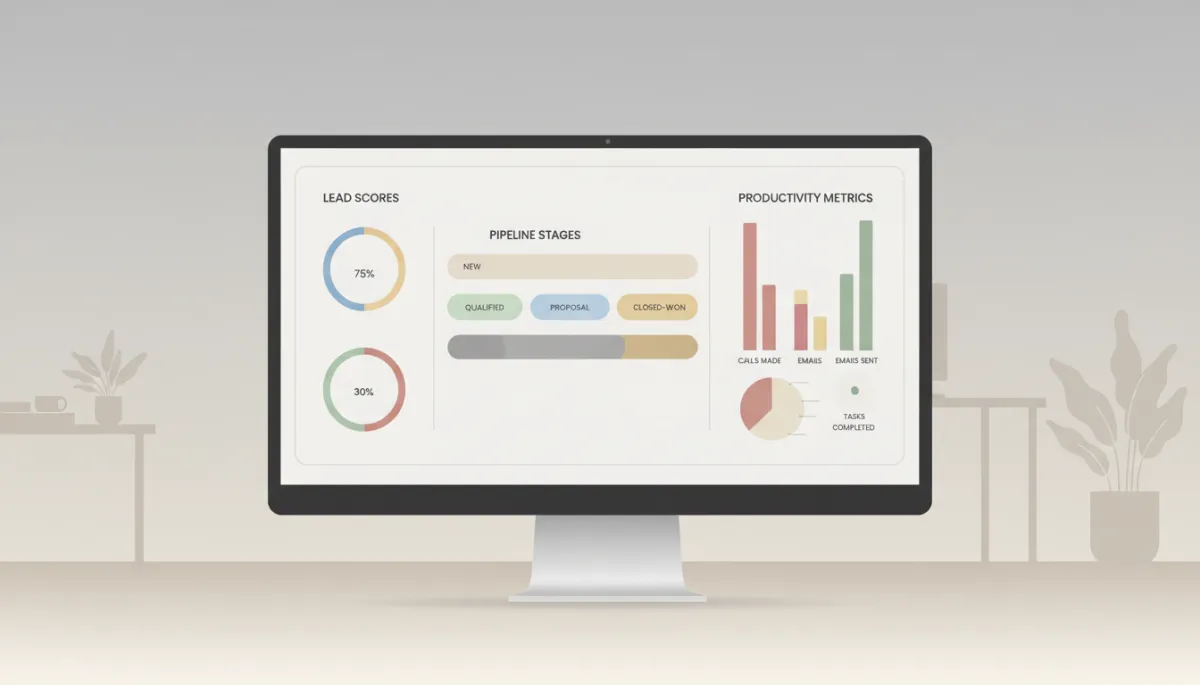
Integrated dashboards reveal how automation improves lead conversion, cycle time, and team productivity.
How to Choose the Right Sales Automation Tool for Your CRM Environment
Selecting an appropriate sales automation platform requires a structured evaluation process that aligns technology capabilities with business objectives, CRM architecture, and user requirements. The right solution should enhance, not complicate, your existing CRM strategy. It must support your lead management model, sales methodology, reporting framework, and compliance obligations while remaining flexible enough to adapt as your organization evolves. A disciplined selection process reduces the risk of fragmented tools, redundant functionality, and low user adoption that can undermine productivity and efficiency gains.
Essential Features to Prioritize in Sales Automation Software
When evaluating platforms, start by mapping core requirements across lead management, workflow automation, analytics, and user experience. At a minimum, the solution should offer robust integration with your CRM, configurable workflows, and comprehensive activity tracking. Look for advanced lead scoring, dynamic segmentation, and flexible cadence builders that enable your team to implement nuanced engagement strategies without relying on extensive custom development. Strong reporting and dashboard capabilities are equally important, as they enable sales operations and leadership teams to monitor performance and refine processes over time.
Usability and adoption are critical success factors. An intuitive interface, embedded guidance, and role-specific views reduce training overhead and encourage consistent usage. Mobile accessibility, offline support, and integration with productivity tools such as email and calendar systems further enhance day-to-day usability. Finally, consider security, compliance, and governance features, including role-based access controls, audit trails, and data residency options, particularly if you operate in regulated industries or manage sensitive customer information.
Comparing Platform Options and Assessing Integration Depth
Not all sales automation platforms are created equal, particularly when it comes to CRM integration depth and ecosystem maturity. Some solutions are native modules within leading CRM systems, offering tight data alignment, shared configuration models, and consistent user interfaces. Others are best-of-breed tools that integrate through APIs, middleware, or iPaaS connectors. While both approaches can be effective, the optimal choice depends on your existing technology stack, customization requirements, and internal development capabilities. Thorough integration testing is essential to validate that data flows, field mappings, and security controls operate as expected.
During platform comparisons, incorporate both quantitative and qualitative criteria. Quantitative metrics may include total cost of ownership, implementation timelines, and projected productivity improvements. Qualitative factors encompass vendor stability, roadmap alignment, support quality, and reference feedback from organizations with similar use cases. A structured proof-of-concept, using real CRM data and representative workflows, can provide valuable insight into how each platform will perform in your environment and how effectively it will support your lead management, productivity, and efficiency objectives.
Evaluating Scalability, Governance, and Long-Term Fit
Scalability is a key consideration when deploying sales automation in growing organizations. The platform should accommodate increases in data volume, user count, and process complexity without performance degradation or excessive administrative overhead. Multi-region deployments, multi-language support, and flexible role hierarchies become increasingly important as organizations expand geographically or diversify their product portfolios. Ensure that the platform’s architecture, licensing model, and support structure can sustain your projected growth trajectory over a multi-year horizon.
Governance and change management capabilities are equally important. As automation rules proliferate, organizations must maintain clear ownership, documentation, and approval processes to prevent conflicting workflows, data quality issues, or unintended customer experiences. Look for features such as versioning, sandbox environments, and granular permissions that support controlled experimentation and structured rollouts. By selecting a platform that balances power with governance, you create a sustainable foundation for ongoing innovation in sales automation and CRM optimization.
Implementing Sales Automation: From Strategy to Execution
Successful implementation of sales automation is as much an organizational change initiative as it is a technology project. To realize the full benefits for CRM, productivity, efficiency, and lead management, organizations must align stakeholders, define clear objectives, and execute a phased rollout plan. A disciplined approach reduces disruption, accelerates adoption, and ensures that automation reinforces, rather than conflicts with, your established sales methodology and customer experience standards.
Key Steps for Transitioning from Manual to Automated Processes
Begin by conducting a comprehensive audit of current sales processes, touchpoints, and data flows. Document where information originates, how it is captured in the CRM, and which steps are prone to delays, errors, or inconsistency. This diagnostic exercise will surface high-impact automation opportunities, such as lead routing, meeting scheduling, or opportunity stage updates. Prioritize use cases that deliver measurable improvements in productivity, efficiency, or lead conversion without introducing excessive complexity in the initial phase.
Next, design standardized workflows that reflect best practices and align with your CRM data model. Collaborate with sales, marketing, and operations stakeholders to define triggers, actions, and exception handling rules. Implement these workflows in a test environment, validate them with a pilot group of users, and refine configurations based on feedback and performance metrics. Once validated, roll out automation in stages, accompanied by clear communication, training, and support resources. This iterative approach minimizes disruption and builds organizational confidence in the new tools and processes.
Overcoming Common Adoption Challenges and Driving User Engagement
Resistance to change, concerns about loss of control, and skepticism about data quality are common barriers to adoption. Address these proactively by involving frontline sellers in design decisions, highlighting how automation will reduce administrative burden, and demonstrating early wins through pilot programs. Establish clear success metrics—such as reduced time-to-first-touch for new leads, increased activities per representative, or improved forecast accuracy—and communicate progress regularly. Visible improvements in productivity and efficiency help build momentum and reinforce the value of the new system.
Governance structures, such as a cross-functional steering committee or center of excellence, can further support sustained adoption. These groups provide a forum for prioritizing enhancements, resolving conflicts, and sharing best practices across teams. Regular feedback loops—through surveys, office hours, or user councils—ensure that the automation roadmap remains aligned with evolving business needs and that the platform continues to support, rather than constrain, high-performance selling behaviors.
Training Sales Teams to Maximize Automation and CRM Value
Comprehensive, role-specific training is essential to ensure that sales teams can fully leverage automation capabilities within the CRM. Training programs should extend beyond basic navigation to focus on how automation supports daily workflows, opportunity strategies, and performance objectives. Scenario-based exercises, using real or simulated opportunities, help representatives understand when and how to enroll leads in cadences, interpret lead scores, and respond to system-generated alerts. Emphasizing the direct link between system usage, personal productivity, and quota attainment reinforces the relevance of the training content.
Ongoing enablement is equally important. As new automation features, sequences, or reporting dashboards are introduced, provide concise, targeted updates through micro-learning modules, knowledge base articles, or in-app guidance. Managers should be equipped with coaching tools and reports that help them monitor usage patterns, identify skill gaps, and reinforce best practices in team meetings and one-on-one sessions. By embedding training and reinforcement into existing sales rhythms, organizations can sustain high adoption levels and continuously improve the impact of their automation investments.
The Future of Sales Automation and CRM Integration
The convergence of sales automation and CRM is accelerating, driven by advances in data infrastructure, artificial intelligence, and customer experience expectations. Future-ready organizations will treat their CRM not merely as a system of record but as an intelligent engagement platform that orchestrates every interaction across the revenue lifecycle. Automation will increasingly operate in the background, surfacing recommendations, insights, and next-best-actions directly within seller workflows while maintaining strict governance and compliance controls.
Emerging Trends Shaping Sales Automation Technology
Several trends are redefining what organizations can expect from sales automation solutions. Unified data platforms are breaking down silos between marketing, sales, and customer success, enabling more holistic lead management and lifecycle analytics. Low-code and no-code configuration tools are empowering business users to design and iterate workflows without relying exclusively on IT resources, accelerating innovation and experimentation. Embedded collaboration features, such as shared workspaces and integrated communications, are improving alignment between sales and cross-functional stakeholders involved in complex deals.
At the same time, buyers are demanding more personalized, context-aware experiences across channels. This is driving increased investment in behavioral data capture, event-driven architectures, and real-time decision engines that feed directly into CRM and automation workflows. Organizations that can operationalize these capabilities will be better positioned to deliver relevant, timely interactions that differentiate their brand, improve conversion rates, and deepen long-term customer relationships.
The Expanding Role of AI and Machine Learning in Sales Automation
Artificial intelligence and machine learning are increasingly embedded within sales automation and CRM platforms, augmenting human decision-making with predictive and prescriptive insights. AI-driven lead scoring models continuously learn from historical conversion data, adjusting weights and thresholds to improve prioritization accuracy over time. Conversation intelligence tools analyze call recordings and meeting transcripts to identify patterns associated with successful outcomes, providing actionable coaching recommendations for sales managers and representatives.
Generative AI is also beginning to influence content creation and personalization, assisting with drafting emails, proposals, and call summaries that are tailored to each buyer’s context while remaining aligned with brand and compliance guidelines. As these capabilities mature, organizations will need robust governance frameworks to manage model training data, bias mitigation, and human oversight. When implemented responsibly, AI-enhanced automation can significantly amplify the productivity and efficiency of sales teams, deepen CRM insights, and elevate the overall quality of lead management and customer engagement.
Conclusion: Aligning Sales Automation, CRM, and Revenue Strategy
Sales automation software, when tightly integrated with a well-governed CRM, is a powerful catalyst for improved productivity, operational efficiency, and lead management effectiveness. By automating repetitive tasks, standardizing best-practice workflows, and providing deeper visibility into pipeline dynamics, these tools free sales professionals to focus on high-value, relationship-driven activities that directly impact revenue outcomes. At the same time, leadership gains a more accurate, data-driven view of performance, enabling better forecasting, resource allocation, and strategic planning.
Realizing these benefits requires more than technology alone. Organizations must invest in process design, change management, and ongoing enablement to ensure that automation reinforces their sales methodology and customer experience standards. As AI and advanced analytics continue to evolve, the intersection of sales automation and CRM will only become more strategic. Organizations that approach this transformation thoughtfully—grounded in clear objectives, strong governance, and a commitment to continuous improvement—will be best positioned to capture sustainable competitive advantage in increasingly data-driven markets.
