

Benefits of Sales Automation in CRM Systems
CRM, Sales Automation, Website Security
Exploring the Benefits for CRM of Sales Automation Software
Sales automation software has become a critical component of modern customer relationship management (CRM)… By streamlining complex workflows, improving data accuracy, and reinforcing website security, it enables organizations to manage customer interactions more intelligently and efficiently. This article explores the key components of sales automation, the processes that can be automated, and how these tools integrate with CRM platforms while supporting bot verification and other security controls.
Key Components of Sales Automation Software
Sales automation software integrates multiple functions into a unified environment… The objective is to reduce manual effort, enhance the quality of customer data, and provide timely insights for decision-makers. When connected to a CRM platform, these components form a robust ecosystem that supports the entire customer lifecycle, from initial website visit to long-term account management.
Lead and contact management: Automated capture, deduplication, and enrichment of contact records within the CRM, ensuring a single, accurate source of customer information…
Workflow and task automation: Rules-based triggers that assign tasks, schedule follow-ups, and move deals through pipeline stages without constant manual input…
Email and communication sequencing: Predefined outreach sequences that send personalized emails, reminders, and updates based on customer behavior and engagement history…
Analytics and reporting: Dashboards and reports that reveal trends in conversion, pipeline velocity, and campaign performance, feeding back into CRM records…
Security and access controls: Role-based permissions, audit trails, and integrations with bot verification and website security layers to protect customer data…
Boosting Sales Productivity and Efficiency
Productivity gains are among the most visible benefits of sales automation for CRM users… By offloading repetitive tasks to software, sales teams can dedicate more time to consultative conversations, strategic planning, and relationship building. Routine activities—such as logging calls, updating opportunity stages, or sending follow-up emails—are triggered automatically based on predefined logic within the CRM.
These efficiencies also reduce human error. When data flows directly from web forms, chat interactions, and marketing campaigns into the CRM, the risk of missing information or duplicate entries decreases. As a result, managers gain a reliable view of performance, and representatives can trust the information they use when engaging prospects. Over time, this consistency translates into shorter sales cycles and higher close rates…
Improving Lead Management and Nurturing
Effective lead management is essential for maximizing the value of each marketing investment… Sales automation tools enhance CRM capabilities by scoring leads, segmenting audiences, and assigning follow-up actions based on behavior. For example, a visitor who downloads a white paper, attends a webinar, and returns to a pricing page may be prioritized for direct outreach, while a casual blog reader may be placed into a longer-term nurture sequence.
Automation also standardizes lead handoff between marketing and sales. Once a prospect meets a defined qualification threshold, the CRM can create an opportunity, notify the appropriate representative, and provide context on the lead’s journey. This reduces friction between teams and ensures that high-intent prospects receive timely, relevant communication. Over time, nurturing programs—driven by automated workflows—support stronger relationships and higher lifetime value…
Enhancing Sales Forecasting and Reporting
Accurate forecasting depends on consistent, high-quality data within the CRM… Sales automation software contributes by enforcing standardized processes and automatically capturing key milestones. When every stage change, interaction, and outcome is recorded, leaders gain a clearer understanding of pipeline health and revenue projections. Automated alerts can flag stalled deals, unusual activity patterns, or sudden drops in conversion rates, prompting timely intervention.
Reporting capabilities extend beyond simple totals. Modern platforms apply analytics to highlight which campaigns generate the most profitable customers, which segments respond best to specific offers, and which sales behaviors correlate with long-term retention. These insights inform strategic decisions, from territory design to product development, and strengthen the organization’s ability to respond to changing market conditions…
Which Sales Processes Can Be Automated?
Many elements of the sales cycle lend themselves to automation when supported by a capable CRM… The goal is not to remove human interaction but to ensure that human effort is focused where it adds the most value. Well-designed automation frameworks handle repetitive tasks while preserving the flexibility required for complex negotiations and bespoke solutions.
Lead capture and enrichment from website forms, live chat, and landing pages…
Qualification workflows that score and route leads based on defined criteria…
Email campaigns, follow-ups, and reminders triggered by customer actions…
Pipeline updates, opportunity creation, and renewal notifications…
Reporting schedules, performance scorecards, and executive summaries…
Automating Lead Generation and Qualification
Lead generation often begins on the organization’s website… Visitors complete forms, interact with chatbots, or sign up for newsletters. Sales automation software, integrated with the CRM, captures this data instantly. It can validate email addresses, check for existing records, and enrich profiles with firmographic or demographic information from trusted data providers. This process reduces manual research and speeds up the time to first contact.
Qualification rules then evaluate each lead based on factors such as company size, industry, budget, and engagement level. Scores are calculated automatically, and high-priority leads are routed to sales representatives, while others enter nurture programs. This systematic approach ensures that resources are allocated intelligently, preventing promising opportunities from being overlooked while still maintaining consistent communication with earlier-stage prospects…
Streamlining Email Communication and Follow-ups
Email remains a central channel for sales communication… Without automation, maintaining timely, personalized outreach at scale is challenging. Sales automation tools address this by enabling sequence-based email campaigns directly connected to CRM records. Templates can be personalized using fields such as name, company, industry, and recent activity, ensuring relevance without requiring manual drafting for each contact.
Follow-up rules define how the system responds to opens, clicks, and replies. If a prospect engages with a proposal link, the CRM can create a task for the representative or trigger a reminder to call. If there is no response after several attempts, the contact may be moved to a different nurture path. This disciplined, automated cadence prevents opportunities from slipping through gaps and supports a consistent experience across the customer base…
Simplifying Sales Pipeline Management
Managing a complex sales pipeline manually can be time-consuming and error-prone… Sales automation software simplifies this process by automatically updating stages, probabilities, and expected close dates based on defined rules and user actions. For example, when a quote is sent or a contract is uploaded, the opportunity stage can advance, and related tasks can be generated without additional data entry.
Visual pipeline views within the CRM provide real-time insight into deal volume, value, and progression. Automation can also identify bottlenecks—such as stages where deals remain for extended periods—and escalate these for review. By maintaining an accurate, dynamic pipeline, organizations can forecast more reliably and allocate resources effectively, from staffing decisions to marketing investments…
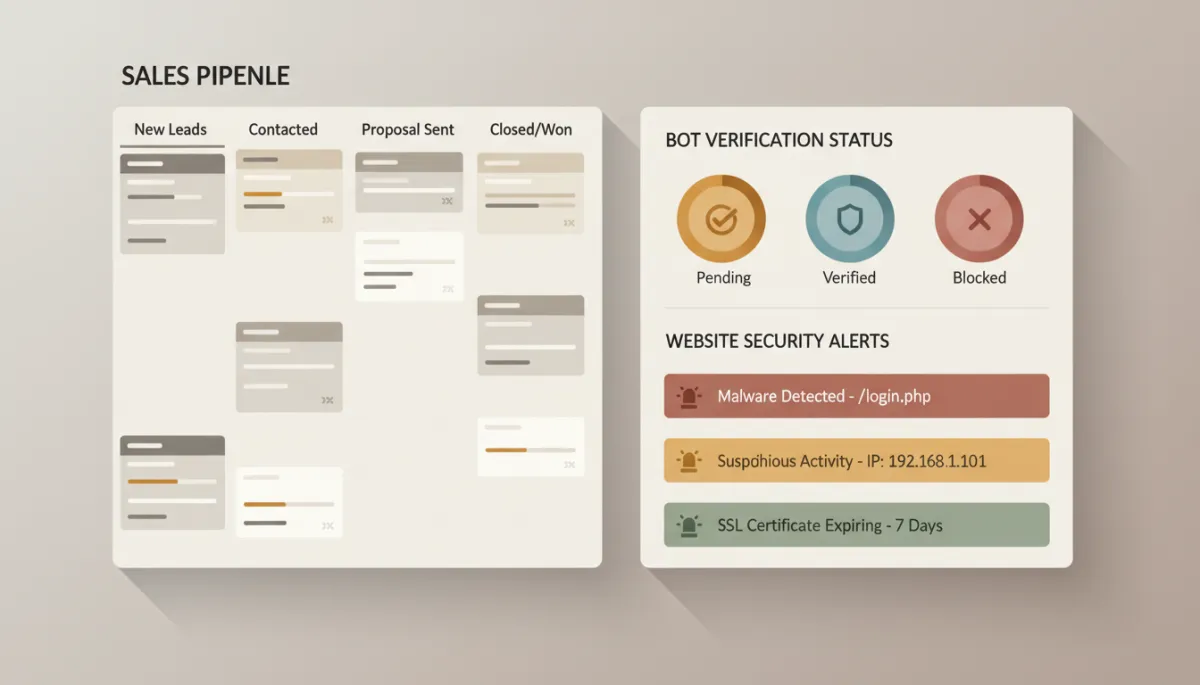
Unified dashboards help teams monitor pipeline health and security signals simultaneously.
How to Choose the Right Sales Automation Tool for Your Team
Selecting an appropriate sales automation platform requires a structured evaluation… Organizations should begin by clarifying their objectives: whether the primary focus is lead generation, account management, forecasting accuracy, or a combination of these priorities. Once goals are defined, teams can assess available solutions against functional, technical, and security requirements, with particular attention to CRM integration quality.
Essential Features to Look for in Sales Automation Software
Certain capabilities are fundamental for any organization seeking to strengthen its CRM through automation… These features not only enhance daily operations but also support long-term scalability and governance. When reviewing potential tools, decision-makers should verify that the following elements are present and mature:
Deep, real-time integration with the existing CRM system, eliminating data silos…
Flexible workflow automation, including branching logic, time-based triggers, and conditional rules…
Robust analytics and reporting tools that surface actionable insights rather than raw numbers alone…
Strong security features, including encryption, access controls, and support for bot verification and website security integrations…
Comparing Popular Sales Automation Platforms
The market for sales automation tools is diverse… Some platforms are built as extensions of established CRM systems, while others operate as independent layers that integrate with multiple back-end databases. During comparison, organizations should evaluate usability, implementation complexity, total cost of ownership, and the vendor’s roadmap for innovation, including planned enhancements to AI, security, and compliance features.
It is also advisable to conduct pilot projects or proof-of-concept deployments. These limited implementations allow teams to test how well a platform supports real workflows, integrates with existing website forms and security systems, and is adopted by users. Feedback from sales representatives, marketing teams, and IT security specialists should all inform the final selection…
Assessing Scalability and Integration Capabilities
Scalability is essential for organizations expecting growth… As lead volumes increase and product lines expand, the automation platform must handle higher data throughput without performance degradation. Integration capabilities are equally important. The tool should connect seamlessly with CRM, marketing automation, customer support platforms, and website security layers, including web application firewalls and bot management solutions.
A scalable architecture will also support regional expansion and evolving privacy requirements. Features such as data residency controls, granular consent management, and detailed audit logs help organizations maintain compliance while continuing to benefit from automation. Considering these aspects during selection reduces the likelihood of costly migrations in the future…
Real-World Examples of Successful Sales Automation
Organizations across industries have realized measurable benefits by aligning CRM strategies with sales automation… A software-as-a-service provider, for instance, may automate trial sign-up flows, onboarding sequences, and renewal reminders. As a result, sales teams receive a steady stream of well-qualified opportunities, supported by detailed usage data captured within the CRM and surfaced in dashboards for account managers.
In another scenario, a business-to-business manufacturer can integrate website quote requests directly into its CRM. Automated rules assign inquiries to appropriate regional representatives, generate preliminary pricing estimates, and schedule follow-up calls. Over time, the organization gains insight into which product lines and territories generate the most profitable deals, enabling more targeted marketing and more accurate capacity planning…
Implementing Sales Automation in Your Organization
Implementation should be approached as a structured change initiative rather than a simple software installation… Success depends on aligning technology, processes, and people. Before activating new workflows, organizations must document existing practices, identify pain points, and define clear success metrics. This foundation allows teams to design automation that supports business objectives instead of merely replicating inefficient legacy routines.
Steps to Transition from Manual to Automated Sales Processes
A phased transition minimizes disruption… Organizations typically begin with a limited set of use cases—such as automated lead capture and basic email sequences—before expanding to more complex workflows. Key steps often include mapping current processes, defining target-state flows, configuring the automation platform, testing with a small user group, and then rolling out to the broader team with appropriate training and support.
Throughout this journey, it is important to monitor performance and gather feedback. Metrics such as response time, conversion rates, and user satisfaction help determine whether automation is delivering the expected value. Adjustments can then be made to rules, content, and routing logic. This iterative approach ensures that the system continues to evolve alongside business needs…
Overcoming Common Challenges in Adoption
Resistance to change is a frequent obstacle when introducing automation… Sales professionals may be concerned about losing control over customer interactions or being evaluated solely through metrics. Clear communication about the purpose of automation—supporting, not replacing, human expertise—is essential. Involving representatives in the design of workflows can also increase buy-in and ensure that the system reflects real-world scenarios.
Technical challenges may arise as well, particularly when integrating multiple systems. Close collaboration between sales operations, IT, and security teams helps address these issues. Establishing governance structures, including data standards and change management processes, prevents fragmentation and maintains the integrity of CRM data over time…
Training Your Sales Team on Automation Tools
Comprehensive training is essential for realizing the full benefits of sales automation… Programs should address both technical skills—such as navigating dashboards and configuring personal views—and strategic concepts, including how to interpret automation-driven insights and adjust outreach accordingly. Training delivered through a combination of live sessions, self-paced modules, and practical workshops tends to be most effective.
Ongoing support is equally important. As new features are introduced or workflows are refined, refresher sessions and updated documentation help maintain proficiency. Encouraging peer-to-peer knowledge sharing, such as internal user groups or champion networks, can further strengthen adoption and foster a culture of continuous improvement…
Bot Verification and Website Security in Sales Automation
As organizations rely more heavily on digital channels for lead generation, bot verification and website security become central to effective CRM and sales automation… Unchecked automated traffic can pollute lead databases with fake entries, distort analytics, and expose systems to abuse. Integrating security controls directly into the lead capture and automation stack protects both data quality and customer trust.
Why Bot Verification Matters for CRM Data Quality
Bot verification tools distinguish genuine human visitors from automated scripts… When embedded into website forms, chat widgets, and signup flows, these solutions prevent malicious or low-quality submissions from entering the CRM. This protection is vital for sales automation, which assumes that incoming leads represent real prospects. If bots flood the system, automated workflows may waste time nurturing non-existent contacts, inflating metrics and obscuring true performance.
By filtering traffic at the source, bot verification preserves the integrity of scoring models and segmentation rules. Sales teams can then rely on automation-driven prioritization, confident that high-scoring leads represent authentic interest. In addition, clean data reduces the risk of deliverability issues caused by sending campaigns to invalid or malicious addresses, supporting healthier email reputations and more accurate engagement analytics…
Strengthening Website Security Around Automated Workflows
Website security is closely tied to the success of CRM-integrated sales automation… Lead capture forms, APIs, and webhooks create pathways between public-facing sites and internal systems. Without appropriate safeguards, these interfaces can become targets for injection attacks, credential stuffing, or data exfiltration attempts. Aligning automation initiatives with a comprehensive security strategy mitigates these risks and supports regulatory compliance.
Best practices include deploying web application firewalls, enforcing encryption in transit, and applying strict authentication and authorization controls to integration endpoints. Regular security assessments and penetration tests help identify vulnerabilities introduced by new workflows or third-party tools. When security and sales operations collaborate closely, organizations can innovate confidently, knowing that efficient automation does not compromise the protection of customer data…
The Future of Sales Automation and CRM Integration
The relationship between CRM systems and sales automation will continue to deepen… Emerging technologies are expanding what is possible, from predictive analytics that anticipate customer needs to intelligent assistants that recommend next-best actions. At the same time, evolving privacy expectations and regulatory frameworks will require organizations to balance personalization with responsible data stewardship and strong security controls.
Emerging Trends in Sales Automation Technology
Several trends are shaping the next generation of sales automation… Deeper integration between marketing, sales, and service platforms is creating unified customer records that span the entire lifecycle. Low-code and no-code tools are enabling business users to design and adjust workflows without extensive technical expertise. Meanwhile, real-time data streaming is allowing CRM systems to respond instantly to customer behavior across channels, from websites to mobile applications.
Security capabilities are evolving in parallel. Advanced bot detection, behavioral analytics, and anomaly monitoring are being embedded directly into customer engagement platforms. This convergence ensures that as automation becomes more powerful, safeguards also become more intelligent, preserving trust while enabling innovation…
The Role of AI and Machine Learning in Sales Automation
Artificial intelligence and machine learning are increasingly central to advanced sales automation… These technologies analyze historical and real-time data to identify patterns that may not be visible through traditional reporting. For example, models can predict which leads are most likely to convert, which accounts may be at risk of churn, and which combinations of messages and channels yield the strongest responses for each segment.
Within CRM environments, AI-driven recommendations can guide representatives toward the most promising activities at any given moment. At the same time, machine learning supports more sophisticated bot verification and website security measures, distinguishing legitimate user behavior from automated threats with greater precision. When combined, these capabilities create a virtuous cycle: cleaner data enables better models, which in turn drive more effective automation and stronger customer relationships…
Conclusion: Aligning Automation, CRM, and Security
Sales automation software offers substantial benefits for CRM, from improved productivity and lead management to more accurate forecasting and richer insights… Yet these advantages can only be fully realized when automation is implemented thoughtfully, integrated seamlessly with existing systems, and supported by strong website security and bot verification practices. Organizations that treat automation, data quality, and security as interconnected priorities will be best positioned to build resilient, customer-centric sales operations.
As technology continues to evolve, the most successful teams will be those that combine advanced tools with disciplined processes and a clear focus on customer value. By investing in robust CRM integration, carefully designed workflows, and comprehensive protection of digital touchpoints, businesses can harness sales automation to drive sustainable growth while maintaining the trust and confidence of their audiences…
