
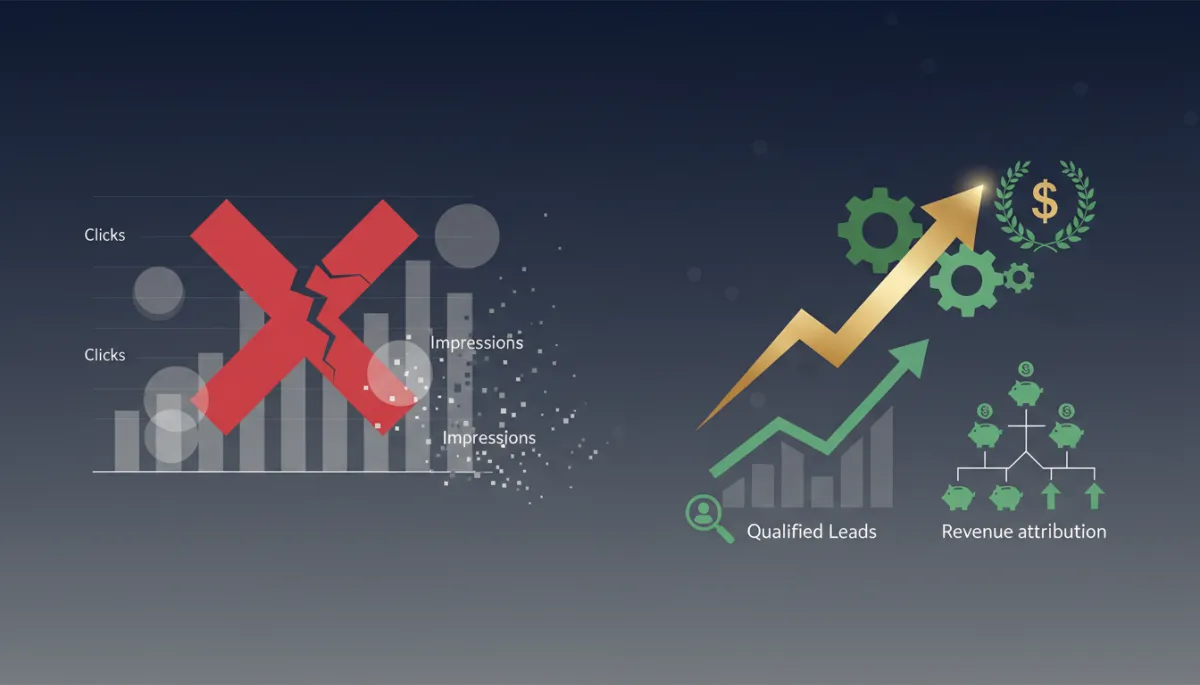
The Death of Vanity Metrics in Marketing
Marketing Strategy, B2B Growth, Revenue Attribution
The Death of Vanity Metrics: Why Clicks and Impressions Aren’t Enough
Marketing is finally having its reckoning. After years of celebrating big numbers—millions of impressions, soaring click-through rates, viral social posts—many leaders are realizing an uncomfortable truth: vanity metrics don’t pay the bills. In a world where every dollar is scrutinized, the real measure of success is not how loud your marketing is, but how effectively it turns attention into qualified pipeline and revenue.
1. The Death of Vanity Metrics
For a long time, marketing dashboards were dominated by numbers that looked impressive but told us very little about business impact: pageviews, impressions, likes, followers, open rates, click-through rates. These vanity metrics were easy to collect, easy to improve, and easy to celebrate in monthly reports. The problem? They rarely answered the question your CEO and CFO actually care about: “How is marketing driving revenue?”
The shift away from vanity metrics isn’t just a trend; it’s a response to real pressure. Economic uncertainty, tighter budgets, and a demand for accountability have forced organizations to confront a simple reality: high engagement without commercial outcomes is a costly distraction. Marketing leaders who once celebrated “record traffic” are now being asked, “How many of those visitors became customers—and how much did they spend?”
📌 Key Takeaway: Vanity metrics may indicate activity, but they rarely prove effectiveness. The future of marketing measurement is tied to pipeline, revenue, and profitability.
What makes a metric “vanity”?
A metric becomes a vanity metric when it looks good on a slide but doesn’t reliably connect to business outcomes or guide better decisions. Ask yourself:
Can this metric be easily manipulated without improving results? (e.g., buying cheap traffic to boost sessions)
Does it correlate with revenue, retention, or profitability in a meaningful way?
Does it help us decide what to do next—budget shifts, campaign changes, sales alignment?
If the honest answer is “no,” you’re likely looking at a vanity metric. That doesn’t mean it’s useless—clicks and impressions still have their place—but they can’t be the headline story of your marketing performance anymore.
2. Why Clicks and Impressions Aren’t Enough
Clicks and impressions are often the first numbers marketers see from a campaign. They’re simple: an impression means someone had the chance to see your message; a click means someone showed a moment of interest. But in isolation, they’re dangerously misleading. You cannot deposit impressions into a bank account.
The illusion of success: a quick example
Imagine two campaigns promoting the same B2B software product:
Campaign A generates 500,000 impressions and 10,000 clicks with a fun, broad message targeting a wide audience.
Campaign B generates 40,000 impressions and 600 clicks, but it targets a narrow segment: operations leaders at mid-market companies in a specific industry.
If you only look at clicks and impressions, Campaign A looks like a clear winner. But when you connect these campaigns to your CRM, you discover:
Campaign A produced a lot of unqualified leads that never progressed past an initial demo.
Campaign B produced fewer leads—but they matched your ideal customer profile, moved through the funnel, and generated three closed-won deals.

When you add revenue to the dashboard, the “best” campaign often changes completely.
On a vanity metrics report, Campaign A wins. On a revenue report, Campaign B is the clear champion. This is why clicks and impressions alone are no longer acceptable as primary success metrics: they describe attention, not outcomes.
The risks of optimizing for the wrong numbers
When teams are rewarded for high click-through rates or low cost-per-click, they naturally optimize for those numbers. That can lead to short-sighted decisions such as:
Using clickbait-style headlines that attract curiosity but not buyers.
Targeting broad audiences because they’re cheaper, even if they’re unlikely to convert.
Prioritizing channels that generate cheap traffic over those that generate profitable customers.
⚠️ Warning: If your incentives and KPIs reward volume over value, you’ll get exactly that—more volume, less value.
Where clicks and impressions still matter
None of this means you should ignore clicks and impressions. They are still useful as diagnostic metrics:
Impressions help you understand reach and brand visibility in a target market.
Clicks indicate whether your message resonates enough to drive initial interest.
The key is to treat them as leading indicators, not final outcomes. They should feed into a bigger story that follows the journey from awareness to revenue—not stop the story at the first interaction.
3. The Shift to Qualified Leads: Quality Over Quantity
If vanity metrics are dying, what replaces them? Increasingly, high-performing marketing teams are aligning around qualified leads—contacts who have both interest and a reasonable likelihood of becoming customers. This shift requires more than a new dashboard; it demands a new mindset and closer collaboration with sales and revenue teams.
What is a “qualified lead”?
A qualified lead is typically defined using two lenses:
Fit: Does this person or account match your ideal customer profile (ICP)? Think company size, industry, geography, tech stack, and role in the organization.
Intent: Is there evidence that they are actively researching or considering a solution like yours? This might include demo requests, pricing page visits, or repeated engagement with bottom-of-funnel content.
Many organizations distinguish between Marketing Qualified Leads (MQLs) and Sales Qualified Leads (SQLs), but the labels matter less than the alignment. What matters is that marketing and sales agree on who is worth pursuing and why.
Why focusing on qualified leads changes everything
When you optimize campaigns for qualified leads instead of raw clicks, several things happen:
Targeting becomes sharper. You prioritize audiences that match your ICP, even if they are more expensive to reach.
Messaging becomes more specific. You speak directly to real pain points and use cases, not generic benefits designed to appeal to everyone.
Sales and marketing alignment improves. Both teams rally around the same definition of a “good” lead, reducing friction and finger-pointing.
💡 Pro Tip: Build your lead scoring model with sales, not in isolation. Their frontline experience is essential to defining “qualified.”
A practical example of quality vs. quantity
Consider a content campaign that offers a broad, top-of-funnel ebook. It generates 2,000 leads at a low cost per lead—but only a handful match your ICP. Contrast that with a targeted webinar on a niche operational challenge, promoted only to specific roles at mid-market companies. It produces 150 leads, but 80% fit your ICP and 20% request a follow-up call. The second campaign will almost certainly drive more pipeline and revenue, even though the vanity metrics look smaller on paper.
4. Revenue Attribution: Connecting Marketing to the Money
The natural evolution from qualified leads is revenue attribution—the practice of mapping marketing activities to the revenue they help generate. This is where marketing truly steps into its role as a growth driver rather than a cost center. Instead of saying, “We drove 10,000 clicks,” you can say, “Our campaigns influenced $2.3 million in pipeline and $750,000 in closed-won revenue this quarter.”
What is revenue attribution?
Revenue attribution is the process of assigning credit for revenue (or pipeline) to the marketing touchpoints that contributed to a deal. It answers questions like:
Which channels are actually generating customers, not just leads?
Which campaigns accelerate deals or increase average contract value?
Where should we invest more—and where should we cut spend?
To do this effectively, you need to connect your marketing automation, website analytics, and CRM data so that you can follow a contact from first touch all the way to closed-won (or lost).
Common attribution models (and what they mean)
Different attribution models answer slightly different questions. A few of the most common include:
First-touch attribution: Gives 100% of the credit to the first interaction (e.g., a blog post or ad that introduced the prospect to your brand). Useful for understanding which channels are best at creating awareness.
Last-touch attribution: Gives all credit to the final interaction before conversion (e.g., a demo request form). Useful for seeing what closes the deal, but it can undervalue earlier nurturing efforts.
Multi-touch attribution: Distributes credit across multiple interactions. This can be linear (equal credit for all touches) or weighted (more credit to first and last touches, or to certain key milestones).
📌 Key Takeaway: No attribution model is perfect, but even an imperfect model is more powerful than guessing based on clicks alone.
Why revenue attribution is central to modern marketing
When you embrace revenue attribution, several benefits emerge:
Budget decisions become data-driven. You can shift spend from low-ROI channels to those that reliably produce revenue, not just traffic.
Marketing earns a strategic seat at the table. When you speak the language of pipeline and revenue, executives listen differently.
Campaigns improve over time. You can test, learn, and iterate based on revenue impact, not just engagement spikes.
Building an EEAT-Driven Measurement Strategy
Behind this shift from vanity metrics to revenue lies a broader principle that search engines and buyers alike are rewarding: EEAT—Experience, Expertise, Authoritativeness, and Trustworthiness. The same qualities that make your content credible in search also make your measurement strategy credible inside your organization.
Experience: Measure what your customers actually experience
Real customer experience doesn’t stop at a click. It spans the entire journey—from first touch to onboarding and beyond. An EEAT-aligned measurement strategy tracks:
How prospects move through your funnel (and where they drop off).
Which content pieces actually contribute to opportunities and closed deals.
How satisfied customers are after purchase (renewals, expansions, referrals).
Expertise and authoritativeness: Proving your impact with data
Experts don’t just claim impact—they demonstrate it. By tying your efforts to qualified leads and revenue, you show that your strategies are grounded in real-world outcomes, not assumptions. Over time, this builds your authority inside the business: leadership sees that when marketing says, “This is working,” it’s backed by pipeline and revenue, not just engagement charts.
Trustworthiness: Transparent, honest reporting
Vanity metrics can be tempting because they’re easy to spin. Revenue-centric metrics are harder to inflate, which is precisely why they build trust. When you are willing to report on:
What didn’t work (campaigns that failed to generate pipeline),
What you learned (insights about audience, messaging, or channel fit),
What you’re changing (how you’ll reallocate budget or adjust strategy),
you signal maturity and integrity. That transparency is the foundation of long-term trust with stakeholders—and it’s impossible to achieve if you’re hiding behind vanity metrics.
How to Transition Away from Vanity Metrics in Practice
Moving from clicks and impressions to qualified leads and revenue attribution doesn’t happen overnight. It’s a strategic shift that touches data, culture, and process. Here’s a practical roadmap to get started:
Redefine your primary KPIs. Elevate metrics like qualified leads, opportunities created, pipeline generated, revenue influenced, and customer lifetime value to the top of your dashboards. Push clicks, impressions, and opens down into a secondary “diagnostic” layer.
Align with sales on qualification criteria. Co-create your definitions of MQL, SQL, and ICP. Document them and revisit them regularly as your market and product evolve.
Integrate your tech stack. Ensure your CRM, marketing automation, and analytics tools are connected so you can trace a path from first touch to closed-won deals. Even basic integrations can unlock powerful insights.
Choose a starting attribution model. Don’t wait for perfection. Begin with first-touch, last-touch, or a simple multi-touch model, then refine as you learn more about your buyer journey.
Educate stakeholders. Bring leadership along on the journey. Explain why some metrics will appear “smaller” in the short term (fewer leads, fewer clicks) but more meaningful in the long term (more revenue, higher conversion rates).
The Future Belongs to Revenue-Driven Marketers
The death of vanity metrics doesn’t mean the end of creativity or bold campaigns. On the contrary, when you anchor your work to qualified leads and revenue attribution, you gain the freedom to experiment more intelligently. You know which ideas actually move the needle and which are just noise. You can defend your budget, justify your strategy, and prove your impact with confidence.
Clicks and impressions will always have a place in marketing, but they can no longer be the story. The organizations that win in the coming years will be those that measure what truly matters: the number of right people reached, the quality of conversations started, and the revenue ultimately generated. Everything else is just a vanity metric waiting to be retired.
If your dashboards are still dominated by big, impressive numbers that don’t tie back to revenue, now is the time to evolve. Rebuild your reporting around qualified leads and revenue attribution, and you’ll not only sharpen your marketing—you’ll elevate its role as a true growth engine for the business.
