
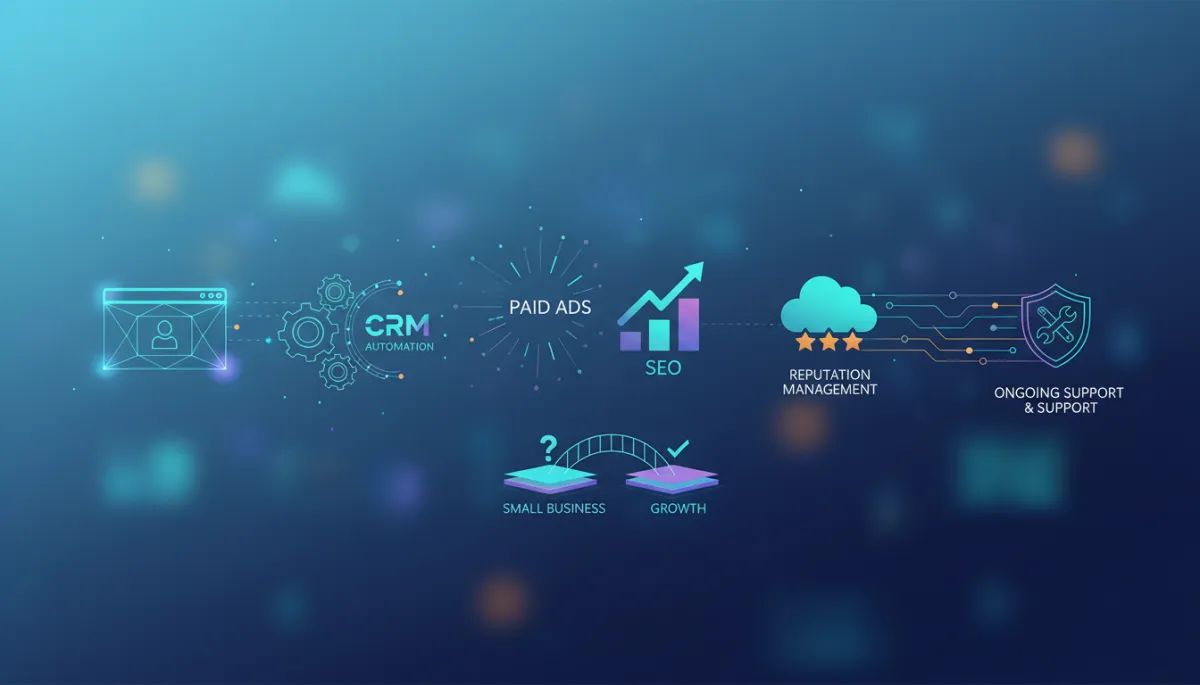
Digital Solutions Agency: Boost Your Online Presence
Digital Marketing, Small Business Growth, Online Presence
What Does a Digital Solutions Agency Actually Do?
Many small business owners know they “need to be online,” but the world of websites, CRM systems, automation, SEO, and paid ads can feel overwhelming. A digital solutions agency exists to make that complexity manageable and to turn your online presence into a reliable driver of revenue, not just a collection of disconnected tools.

What Is a Digital Solutions Agency, in Plain Terms?
A digital solutions agency is a partner that helps your business use digital tools to attract customers, manage relationships, and generate revenue more efficiently. Instead of hiring separate specialists for website design, advertising, automation, and customer relationship management, you work with a single team that understands how all of these pieces fit together into one coherent strategy.
For small businesses, this is particularly valuable. You likely do not have an in-house marketing department, a full-time web developer, and a data analyst on staff. A digital solutions agency fills those gaps, offering a mix of strategy, implementation, and ongoing support tailored to your budget and growth goals. Their role is not just to “build a website” or “run some ads,” but to design a digital ecosystem that consistently brings in the right customers and supports them from first click to long-term loyalty.
1. Website Design: Your Online Storefront and Sales Engine
Most small business owners think of a website as an online brochure. A digital solutions agency treats it as a sales engine. That means designing and building a site that not only looks professional, but also guides visitors toward clear actions such as calling, booking, purchasing, or requesting a quote. Good design is not just about colors and fonts; it is about strategy and user experience.
- Discovery and strategy: Understanding your business model, ideal customers, services, and goals so the site can be structured around them rather than around generic templates.
- Professional visual design: Creating a visual identity that reflects your brand, builds trust, and feels modern and consistent across all pages and devices.
- User experience (UX): Making it easy for visitors to find information, compare options, and contact you, with clear navigation, calls to action, and mobile-friendly layouts.
- Performance and security: Ensuring fast loading times, secure connections, and basic protections against common threats, which also supports better search rankings and user trust.
A strong agency will also build with future updates in mind. Rather than a one-off project, they set up a content management system (such as WordPress or a similar platform) so that pages, blog posts, and service details can be updated as your business evolves. This is crucial for small businesses that need to respond quickly to changes in pricing, services, or market conditions without starting from scratch each time.

A well-designed website turns casual visitors into qualified leads and paying customers.
2. CRM Setup: Organizing and Nurturing Your Customer Relationships
A Customer Relationship Management (CRM) system is the central database where your leads, customers, conversations, and sales activities are organized. For many small businesses, this information lives in scattered spreadsheets, inboxes, and notebooks. A digital solutions agency helps you move from that chaos to a structured, searchable, and actionable system.
- Choosing the right CRM: There are dozens of options, from simple tools to enterprise platforms. An agency evaluates your business size, sales cycle, and budget, then recommends a CRM that fits rather than overselling complexity you do not need.
- Implementation and configuration: Setting up pipelines, tags, custom fields, and stages that match how you actually sell, so your team can see where every lead stands at a glance.
- Integrations with your website and forms: Ensuring that when someone fills out a form on your site, books a call, or downloads a resource, their information goes directly into your CRM with proper tracking.
- Reporting and dashboards: Creating simple views that show how many leads you have, where they come from, and how many convert into customers, so you can make informed decisions.
Proper CRM setup is one of the clearest dividing lines between businesses that grow steadily and those that feel stuck. When your agency connects your website, ads, and email marketing into your CRM, you gain visibility into which activities are driving real revenue, not just traffic or clicks. That insight allows you to invest confidently and stop guessing about what is working.
3. Automation: Saving Time and Preventing Lost Opportunities
Marketing and sales automation refers to the use of software to handle repetitive tasks such as follow-up emails, appointment reminders, and lead nurturing. For a small business owner who wears many hats, automation can mean the difference between a lead being contacted within minutes or forgotten entirely. A digital solutions agency designs automation that feels personal while working in the background for you, 24/7.
- Instant lead responses: When someone submits a form or requests a quote, an automated email or text can acknowledge their inquiry, provide next steps, and set expectations for response time, making your business appear responsive and organized even outside office hours.
- Lead nurturing sequences: A series of scheduled emails that educate prospects, answer common objections, and gently guide them toward a consultation or purchase, without you manually sending each message.
- Appointment and reminder workflows: Automated booking confirmations, calendar invites, and reminders that reduce no-shows and administrative back-and-forth for both your team and your customers.
- Internal alerts and tasks: Automatic notifications to your staff when a new high-intent lead arrives, a quote is requested, or a deal moves to a new stage, so nothing falls through the cracks.
Automation is not about replacing human interaction; it is about ensuring that every potential customer receives timely, consistent communication until a real person on your team can step in. For many small businesses, this alone can recover a significant amount of lost revenue from leads that previously went unanswered or were followed up with too late.
4. Paid Ads: Buying Targeted Attention, Not Just Clicks
Paid advertising on platforms like Google, Facebook, Instagram, and LinkedIn allows you to reach potential customers quickly, but it can also drain your budget if not managed carefully. A digital solutions agency focuses on profitable campaigns, not just traffic. Their job is to connect your ads to your website, CRM, and automation so that you can see the full picture—from ad click to closed sale.
- Audience and keyword research: Identifying the search terms, demographics, and interests that indicate real buying intent, rather than broad, expensive traffic that rarely converts.
- Ad creative and messaging: Writing clear, benefit-focused ad copy and selecting visuals that speak directly to your ideal customer’s problems and desired outcomes.
- Landing pages that convert: Sending ad traffic to tailored pages on your site designed to capture leads or drive purchases, rather than dumping visitors onto a generic homepage where they may get lost or distracted.
- Ongoing optimization: Testing variations of ads, adjusting bids, refining audiences, and pausing underperforming campaigns so your budget is continually reallocated toward what works best.
For small businesses, the key question is usually, “If I spend a dollar, how many dollars come back?” A competent digital solutions agency sets up tracking and reporting so that you can answer that question with data, not guesses. Over time, this allows you to scale what works and confidently reduce or stop what does not, avoiding the common trap of “boosting posts” without a clear strategy or measurable return.

Clear reporting helps small businesses see which campaigns truly generate revenue.
5. SEO: Earning Visibility in Search Results Over Time
While paid ads can bring in traffic quickly, Search Engine Optimization (SEO) focuses on earning visibility in organic (non-paid) search results. For many local and niche businesses, appearing on the first page of Google when someone searches for your services can be a consistent, long-term source of qualified leads. A digital solutions agency approaches SEO as an ongoing process rather than a one-time checklist.
- Technical SEO foundations: Ensuring your site is crawlable, fast, mobile-friendly, and structured in a way that search engines can understand, including clean URLs, proper headings, and secure connections (HTTPS).
- On-page optimization: Researching the phrases your potential customers actually search for and weaving them naturally into page titles, headings, and content so your site is more likely to appear for relevant queries.
- Local SEO and Google Business Profile: Optimizing your presence on Google Maps and local listings, managing categories, photos, and descriptions so that nearby customers can find and choose you over competitors.
- Content strategy: Creating helpful articles, FAQs, and resources that answer the questions your audience is asking, positioning your business as a trusted authority in your field.
SEO is a long-term investment. Results typically build over months, not days. A digital solutions agency helps you set realistic expectations, prioritize high-impact opportunities, and measure progress. For small businesses with limited budgets, this means focusing on the specific keywords and locations that are most likely to produce paying customers, rather than chasing broad, highly competitive terms that larger brands dominate.
6. Reputation Management: Protecting and Growing Your Online Trust
In today’s environment, potential customers often read reviews before they ever speak to you. Online reputation management is the practice of monitoring, improving, and protecting how your business appears across review sites, social platforms, and search results. A digital solutions agency helps you take control of this narrative rather than leaving it to chance.
- Review generation systems: Setting up processes (often automated) to request reviews from satisfied customers at the right moment, such as after a successful service visit or completed project, while making it easy for them to leave feedback on platforms that matter most to you.
- Monitoring and alerts: Keeping track of new reviews and mentions so you can respond promptly, thank happy customers, and address concerns before they escalate.
- Response guidance: Helping you craft professional, calm responses to negative reviews that demonstrate accountability and care, which can often soften the impact and even win back trust from both the reviewer and future readers.
- Showcasing social proof: Highlighting positive reviews and testimonials on your website, landing pages, and marketing materials to strengthen credibility and reduce hesitation from new prospects.
For many small businesses, a handful of strong reviews can significantly improve conversion rates from both paid and organic traffic. Conversely, a neglected profile with outdated information and unanswered complaints can quietly undermine even the best advertising. A digital solutions agency ensures that your online reputation supports your growth rather than holding it back.
7. Ongoing Support: Keeping Your Digital Ecosystem Healthy
One of the most misunderstood aspects of digital work is that it is never truly “finished.” Platforms update their rules, competitors adjust their strategies, and your own business evolves. That is why ongoing support and optimization are a core part of what a digital solutions agency offers, rather than just delivering a one-time project and disappearing.
- Website maintenance: Updating plugins, fixing broken links, improving page speed, and ensuring compatibility with new devices and browsers, so your site remains secure and functional over time.
- Campaign tuning: Reviewing performance data on ads, SEO, and email campaigns, then making incremental improvements to increase return on investment and reduce wasted spend.
- Strategy reviews: Regular check-ins to align your digital efforts with your current business priorities—whether that means promoting a new service, targeting a new location, or shifting focus from lead generation to retention.
- Training and documentation: Helping your team understand how to use the tools that have been implemented, from CRM features to content updates, so you are not dependent on the agency for every small change.
This ongoing partnership model is particularly valuable for small businesses that cannot justify hiring a full-time marketing director, web developer, and marketing operations specialist. Instead, you gain access to a team of experts on a flexible, predictable basis, with clear priorities and measurable outcomes.
How All the Pieces Work Together
Each service—website design, CRM setup, automation, paid ads, SEO, reputation management, and ongoing support—has value on its own. However, the real strength of a digital solutions agency lies in integrating these pieces into a single, coherent system. Consider a simple example of how this might look in practice:
- A potential customer searches for your service on Google and finds your well-optimized website (SEO).
- They click through to a clean, mobile-friendly page that clearly explains your offering and invites them to request a quote (website design).
- When they submit the form, their details are automatically added to your CRM and tagged based on their interest (CRM setup).
- An automated email confirms receipt, shares helpful information, and offers a link to schedule a call (automation).
- Your team receives an internal alert so they can follow up personally, armed with the context stored in the CRM.
- After a successful project, the customer receives a polite request to leave a review, which is then displayed on your site and Google profile (reputation management).
- Your agency reviews the data at the end of the month, identifying which channels and messages brought in the most profitable customers, and adjusts campaigns accordingly (ongoing support and optimization).
In this scenario, each step reinforces the others. Without an integrated approach, you might have a nice website that no one visits, ads that drive traffic but not leads, or a CRM that collects data but never triggers timely follow-up. A digital solutions agency’s job is to ensure the entire journey—from first impression to repeat purchase—is intentional, measurable, and continuously improving.
Hiring a Digital Solutions Agency vs. Doing It Yourself
Many small business owners are resourceful and willing to learn. With enough time and patience, you can certainly build a basic website, run simple ads, or send email campaigns yourself. The key question is not whether you can do it, but whether it is the best use of your time and budget at your current stage of growth. Understanding the trade-offs will help you decide when to partner with an agency and when a do-it-yourself approach is sufficient.
When Doing It Yourself May Make Sense
- Very early-stage or side projects: If your business is just an idea or a small side venture with minimal revenue, starting with a simple do-it-yourself website builder and basic social media presence can be a sensible, low-cost way to test demand.
- Highly limited budgets: If hiring any external help would put undue strain on your finances, it is better to start small and learn the basics yourself than to stretch too thin. In this case, focus on one or two core channels rather than trying to do everything at once.
- Specific skills or interests: If you or someone on your team genuinely enjoys digital marketing and has the time to stay current, you may be able to handle certain aspects in-house, such as content creation or social media, while outsourcing more technical areas.
The Hidden Costs of the DIY Approach
Even when tools are marketed as “easy” or “no-code,” there are still significant time and opportunity costs involved in doing everything yourself. These often show up as:
- Trial-and-error spending: Running ads without proper tracking or strategy can quickly consume your budget with little to show for it. A few misconfigured campaigns can easily cost more than an agency’s setup fee would have.
- Fragmented tools: Using separate systems for website, email, forms, and customer data without proper integration leads to manual work, inconsistent records, and missed opportunities for follow-up and measurement.
- Lost focus on core operations: Every hour spent troubleshooting a plugin, learning a new ad platform, or rewriting web copy is an hour not spent serving customers, improving your product, or leading your team.
When It Makes Sense to Hire a Digital Solutions Agency
- Your business has proven demand and consistent revenue. Once you know there is real demand for your services or products, investing in professional digital infrastructure can help you capture more of that demand efficiently and predictably.
- You are hitting a growth ceiling. If word-of-mouth and referrals have taken you as far as they can, but new customer acquisition has plateaued, an agency can help you design a scalable lead generation and nurturing system.
- You need clarity on what is working. If you are already spending on ads, tools, or freelancers but cannot clearly see the return on each, an agency can audit your setup, implement tracking, and create dashboards that show you where to focus.
- You value speed and expertise. Instead of spending months learning by trial and error, you can leverage an agency’s experience across multiple industries and campaigns to get to a working solution faster, with fewer costly mistakes.
Evaluating the Value: What You Should Expect from an Agency Partner
Once you decide that working with an agency may be the right move, the next step is choosing a partner and understanding what value looks like in practice. Beyond the specific services they offer, a strong digital solutions agency will provide:
- Clear goals and success metrics: Before launching any campaign or project, you should agree on what success looks like—whether that is a certain number of qualified leads per month, a target cost per acquisition, or improved conversion rates on key pages.
- Transparent reporting: Regular, easy-to-understand reports that show performance across your website, ads, SEO, and CRM, along with commentary on what is working and what is being adjusted.
- Strategic recommendations: Not just execution, but thoughtful guidance on where to invest next, which channels to test, and how to align digital efforts with your broader business strategy.
- Responsiveness and communication: A designated point of contact, reasonable response times, and a cadence of check-ins that keeps you informed without overwhelming your schedule.
Ultimately, the value of a digital solutions agency is measured not only in clicks or rankings, but in business outcomes: more qualified leads, higher conversion rates, stronger customer relationships, and a clearer understanding of how your marketing investments translate into revenue. When these outcomes are present, the cost of the agency becomes an investment with a measurable return rather than a vague expense.
Practical Steps for Small Business Owners Considering an Agency
If you are considering partnering with a digital solutions agency, a structured approach will help you make a confident, informed decision. Here are some practical steps you can take:
- Clarify your priorities. Decide what matters most in the next 6–12 months: more leads, higher-quality leads, better follow-up, increased repeat purchases, or improved brand perception. Share these priorities openly with potential agencies.
- Gather your current data. Even if it is messy, collect what you have: website analytics, ad accounts, email lists, and sales numbers. This gives an agency a starting point for assessment and avoids rebuilding everything from zero unnecessarily.
- Ask about integration, not just individual services. When speaking with agencies, ask how they connect website, CRM, automation, ads, SEO, and reputation management into one system. Their answer will reveal whether they think in silos or in terms of end-to-end customer journeys.
- Start with a focused engagement. Rather than trying to overhaul everything at once, consider starting with a clear, well-defined project—such as rebuilding your lead generation funnel or implementing a CRM and automation for a specific service line—then expanding based on results.
By approaching the decision in this way, you position yourself as an informed partner rather than a passive client. The best agencies welcome this level of clarity and collaboration, as it leads to stronger results for both sides.
Bringing It All Together
A digital solutions agency does far more than build websites or run ads. For small businesses, it can serve as an extension of your team—a partner that designs, implements, and maintains the digital systems that support growth. From website design and CRM setup to automation, paid ads, SEO, reputation management, and ongoing support, the agency’s role is to align technology and strategy so that your online presence consistently contributes to your bottom line.
Deciding whether to hire an agency or continue doing it yourself is ultimately a question of leverage. If you are at a stage where your time is better spent leading your team, serving customers, and making strategic decisions, then partnering with specialists to handle the digital complexity is often a sound investment. With the right agency, you gain not just a set of services, but a long-term ally in building a more resilient, scalable, and profitable business.
As you evaluate your options, look for partners who take the time to understand your business, communicate clearly, and focus on measurable outcomes. When those elements are in place, a digital solutions agency can transform your online presence from a collection of disconnected tools into a powerful, integrated growth engine.
