

DIY Website Builders: A Hidden Business Risk
Web Strategy, Conversion Optimization, Professional Development
Your DIY Website Builder Is Secretly Sabotaging Your Business (Do This Instead)
Cheap, template-based websites promise quick wins—but the invisible tax they impose on credibility, conversions, and long-term growth quietly erodes your bottom line. Here is what professionals need to understand before trusting a DIY builder with a serious business.
Your DIY Website Builder Is Secretly Sabotaging Your Business (Here’s What They Don’t Tell You)
When budgets are tight and timelines are aggressive, DIY website builders look like a rational decision. Drag-and-drop editors, bundled hosting, and “professional” templates appear to offer everything a small firm or growing practice needs. The problem is simple—what looks inexpensive on paper often becomes extremely costly once you factor in lost leads, weak authority, and poor conversion performance over time.
Most platforms market themselves as “all you need” solutions. They emphasize ease of use while quietly downplaying structural limitations in design flexibility, technical SEO, performance, and analytics. These constraints create an invisible ceiling on how far your website can support your business—no matter how hard you work on content or how much traffic you drive through paid campaigns and social channels.
Professionals who treat their website as a serious business asset eventually discover the same truth—DIY tools are fundamentally built for convenience, not for strategic growth. To understand why, you need to examine the three areas where cheap sites quietly underperform: structural limitations of DIY platforms, conversion optimization constraints, and the missed opportunity of professional web development.
The Template Trap: Why Your DIY Site Screams “Amateur” to Visitors
DIY website builders rely on mass-produced templates. At first glance, these designs appear modern and polished. But the more you look, the more you notice the same hero sections, identical typography, and predictable layouts repeating across thousands of businesses in unrelated industries. For discerning visitors—especially B2B decision-makers—this repetition communicates one thing: generic and low investment.
Brand alignment is the first casualty. Templates are built to be broadly appealing, which means they are intentionally neutral and non-specific. Your brand, however, is not neutral. It has a defined positioning, a particular audience, and a specific value proposition. When you force that uniqueness into a rigid template, you dilute it. The result is a site that looks acceptable but fails to differentiate you from competitors using the same or similar layouts.
The second problem is structural inflexibility. As your services evolve, your offers become more sophisticated, or your content strategy matures, you quickly hit the limits of what the template can reasonably support. You may want a new layout for case studies, a more robust resource library, or a different way to display pricing and value tiers. DIY editors allow small cosmetic changes—but deeper structural adjustments often require workarounds, custom code snippets, or compromises that degrade usability and visual hierarchy.
📌 Key Takeaway: When your website looks and behaves like a template, visitors assume your services are equally generic—no matter how strong your actual expertise may be.
The Hidden SEO Ceiling: Why DIY Platforms Struggle to Rank
Most DIY builders advertise “SEO-friendly” features—editable meta tags, custom URLs, and basic sitemaps. For many non-technical users, that sounds sufficient. Yet search visibility is driven by far more than page titles and descriptions. Technical SEO, site architecture, and performance signals play a decisive role in how search engines evaluate and rank your content. This is where DIY platforms quietly impose a ceiling you cannot easily break through.
Page speed is a prime example. Template-based builders often bundle visual effects, third-party scripts, and heavy styling into their core framework. Even if you keep your design minimal, you are still carrying the weight of the platform’s underlying code. Slow-loading pages are penalized—both by search engines and by human visitors who abandon sluggish experiences in seconds. You cannot meaningfully refactor this code without leaving the platform entirely, which keeps you locked into an underperforming baseline.
Structural SEO is another constraint. Clean URL hierarchies, schema markup, optimized internal linking, and flexible content models are essential for scaling organic traffic. Many DIY tools provide only superficial control over these elements. You may be able to adjust a slug or add a meta description, but you cannot fully control how content types relate to each other, how structured data is implemented, or how deeply your site architecture can be customized to support a long-term content strategy.
💡 Pro Tip: If your platform decides how your site is structured, you are accepting its SEO ceiling—no matter how strong your content may be.
Conversion Killers: The Design Flaws Driving Prospects Away
Traffic without conversions is a vanity metric. For professional services, SaaS, and B2B firms, the real measure of a website is simple—does it consistently turn the right visitors into qualified leads, booked consultations, or direct sales? DIY sites struggle here because they are not engineered around conversion optimization principles. They are built to make layout changes easy, not to make decision-making effortless for your prospects.
Effective conversion design demands clarity of hierarchy, focused messaging, and frictionless paths to action. DIY templates, by contrast, tend to prioritize visual flourish and generic section patterns over strategic flow. You get large hero images with vague headlines, scattered calls-to-action, and competing elements that dilute attention. Without a deliberate information architecture and conversion strategy, visitors must work harder to understand what you do, why it matters, and what to do next—most simply will not make that effort.
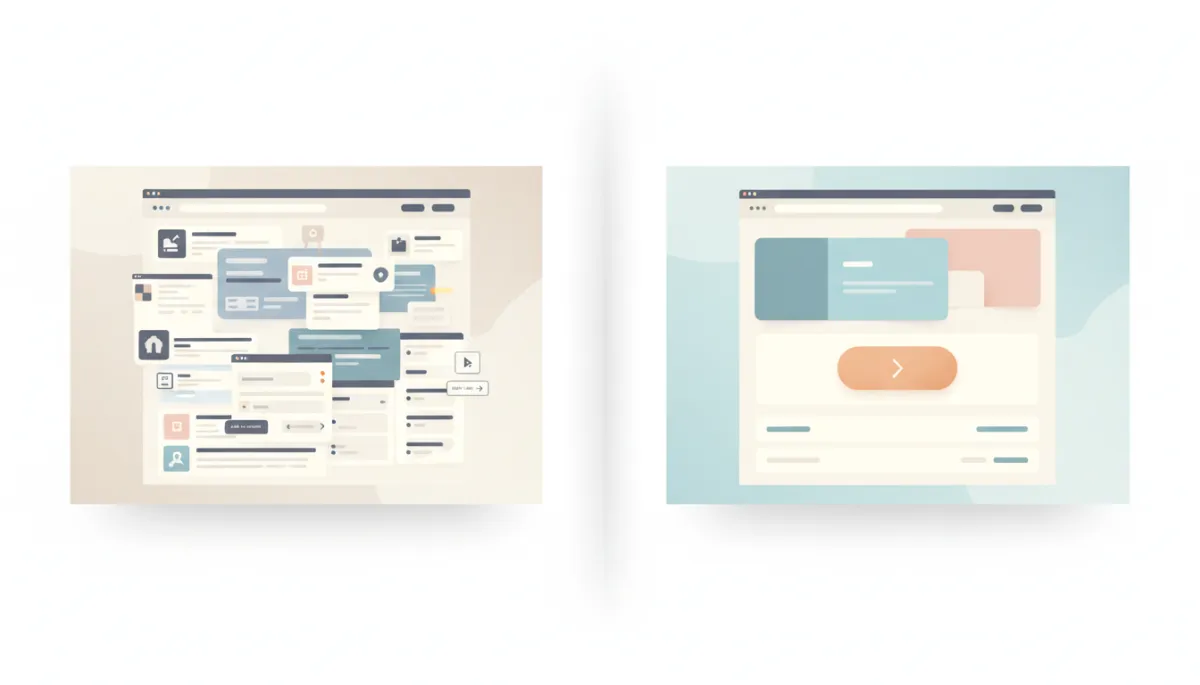
-toned split-screen showing on the left a cluttered DIY website with weak call-to-actions and on...
Strategic layout and targeted calls-to-action routinely double or triple lead conversion rates.
Measurement is the next missing piece. Serious conversion optimization relies on A/B testing, event tracking, funnel analysis, and user behavior insights. While some DIY platforms offer basic analytics integrations, they rarely provide the granular control needed to track micro-conversions—scroll depth, click heatmaps, form abandonment, or multi-step funnel drop-off. Without that clarity, you are left guessing which changes help and which quietly harm performance, turning optimization into trial-and-error rather than data-driven refinement.
📌 Key Takeaway: A website that is easy to build is not automatically easy to buy from—conversion-focused design requires intent, testing, and professional execution.
The Security Illusion: Convenience Is Not the Same as Protection
Many business owners assume that hosting on a major DIY platform automatically guarantees strong security. To be clear—these providers do invest in infrastructure-level security. However, the perception that “the platform handles everything” can create complacency around critical risk areas. Misconfigured integrations, outdated third-party scripts, weak access controls, and poor data handling practices still occur on DIY sites, especially when non-technical users install plugins or connect external tools without proper review.
Beyond technical vulnerabilities, there is also the matter of control. On closed DIY ecosystems, you are bound by the platform’s policies, uptime record, and change roadmap. If they alter pricing, deprecate features you rely on, or experience service disruptions, your business absorbs the impact. You have limited ability to audit, harden, or customize the environment. For organizations handling sensitive information, regulated data, or high-value transactions, this lack of control can become a strategic liability—not just a technical inconvenience.
The Hidden Costs: When “Affordable” Becomes Expensive
DIY website builders position themselves as the cost-effective alternative to professional development. Monthly fees look modest, and the upfront investment appears minimal. What those price comparisons ignore is the opportunity cost of a website that underperforms for years. Every lost lead, abandoned quote request, or missed consultation booking is revenue that never appears on your balance sheet—but it is very real, and it compounds over time.
Consider a conservative scenario. If your website could realistically convert one additional qualified client per month with a more effective design and optimized flow, what would that be worth annually? For many professional services firms, that figure easily reaches tens of thousands of dollars. Against that backdrop, the perceived savings of a $30-per-month DIY subscription quickly evaporate. The “cheap” option becomes one of the most expensive decisions you can make because it suppresses revenue rather than enabling it.
💡 Pro Tip: Evaluate website costs in terms of lifetime revenue impact—not subscription fees or initial build expenses.
The Professional Alternative: What Custom Development Actually Delivers
Professional web development is not about adding complexity—it is about aligning your digital presence with your business strategy. A custom-built site starts with discovery: who you serve, how you create value, what differentiates you, and what actions matter most. From there, designers and developers architect an experience that supports those goals, instead of forcing them into a pre-made template meant to serve everyone and therefore no one in particular.
From a technical standpoint, professional builds give you control over performance, structure, and integrations. Lightweight, well-organized code improves load times. Thoughtful information architecture supports both human navigation and search engine crawling. Robust analytics setups track key events throughout the user journey, feeding real data into future optimization decisions. Security configurations are tailored to your risk profile, and infrastructure can be selected to meet your specific reliability and compliance needs rather than the average use case of a DIY platform’s customer base.
Most importantly, professional development enables systematic conversion optimization. Instead of hoping that a template’s default layout will persuade, your site is intentionally designed around user behavior, persuasive copy, and clear calls-to-action. Landing pages can be tailored to campaigns, lead magnets can be integrated with your CRM, and booking flows can be streamlined to reduce friction. Over time, you can test variations, refine messaging, and continuously improve performance—something that is extremely difficult to execute effectively within the constraints of a DIY builder.
DIY Website Limitations vs. Strategic Web Assets
At its core, the decision is not “DIY versus custom code”—it is tactical convenience versus strategic ownership. DIY websites are tools for getting something online quickly. Professional websites are vehicles for building authority, generating demand, and supporting long-term growth. When you view your site as a strategic asset, the limitations of DIY platforms become unacceptable: generic templates, constrained SEO, shallow analytics, and minimal control over performance and security posture.
Professionals who outgrow DIY tools do so because they recognize that their website is often the first serious interaction a prospect has with their brand. That interaction should not be governed by the design sensibilities of a template marketplace or the technical trade-offs of a low-cost platform. It should be governed by your positioning, your clients’ expectations, and measurable business outcomes. That shift in perspective is what justifies investing in professional web development—and it is why that investment tends to pay for itself many times over.
📌 Key Takeaway: A serious business cannot rely on a website designed for hobbyists—your digital presence must reflect the caliber of your services.
How to Know If You Are Ready to Move Beyond DIY
Not every organization needs to abandon DIY immediately. However, there are clear signs that your current platform is holding you back. If any of the following resonate, it is time to seriously evaluate a transition to professional development:
You rely on your website for lead generation, yet conversions remain consistently low despite increased traffic.
Prospects comment that your site “does not match” the quality of your work or your in-person presence.
You struggle to execute new marketing initiatives because the platform cannot support the layouts or integrations required.
Your team spends significant time wrestling with DIY limitations instead of focusing on core business activities.
You cannot clearly attribute revenue to website-driven opportunities because tracking is incomplete or unreliable.
These are not minor inconveniences—they are indicators that your website is operating as a cost center rather than a growth engine. When that is the case, the question is no longer whether you can justify professional web development. The question is how much longer you can afford to delay it without sacrificing additional revenue and market position.
The Next Step: Conducting a Professional Website Assessment
Moving beyond DIY does not mean rebuilding everything blindly. The most effective first step is a structured assessment of your current site—evaluating design, content, technical health, SEO, and conversion performance. A professional assessment identifies what is working, what is limiting you, and where the highest-impact improvements lie. It also helps you prioritize investment, so you are not simply “redesigning” for aesthetics, but rebuilding strategically around measurable goals.
During this process, experienced web professionals will review analytics data, analyze user journeys, audit technical configuration, and benchmark your site against competitors and best practices. The outcome should be a clear roadmap: which pages to restructure, which flows to streamline, which integrations to implement, and which content to enhance or retire. That roadmap becomes the foundation for a professional build that finally aligns your digital presence with the reality of your business ambitions.
💡 Pro Tip: Treat your website assessment like a financial audit—its purpose is to reveal hidden risks and unrealized opportunities, not simply to critique design.
Conclusion: Stop Paying the Invisible Tax of a Cheap Website
DIY website builders have their place—they are suitable for personal projects, early experiments, and businesses that are not yet ready to treat their digital presence as a core asset. But for professionals who rely on their website to generate leads, close deals, and reinforce credibility, these platforms impose a quiet but persistent tax on growth. Template constraints, SEO ceilings, weak conversion optimization, and limited control all compound into one outcome: a site that looks acceptable yet underperforms where it matters most—revenue and reputation.
The alternative is not merely a “nicer” design. It is a professionally developed website built as a strategic asset—engineered for speed, designed for conversion, aligned with your brand, and supported by data-driven optimization. If your business has moved beyond the startup experiment phase, your website should reflect that maturity. The sooner you stop relying on tools built for convenience and start investing in a platform built for performance, the sooner your online presence will begin to match the true value of what you deliver offline.
