
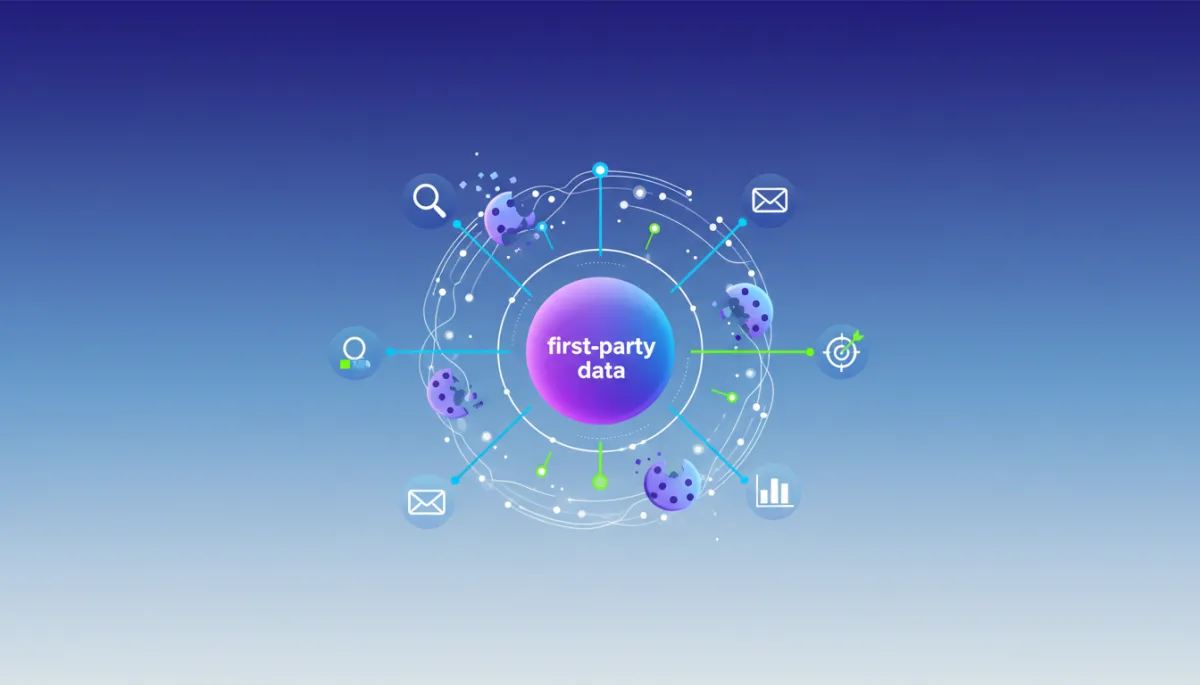
Future of Digital Marketing: First-Party Data
Digital Marketing, First-Party Data, Privacy-First Strategy
Why First-Party Data Is the Future of Accurate Digital Marketing
As third-party cookies disappear and privacy rules tighten, accurate digital marketing is no longer about renting audiences from others. It is about earning, growing, and activating the data you collect directly from your customers. This is the promise—and the pressure—of first-party data.
From Cookie Comfort Zone to Cookieless Reality
For nearly two decades, third-party cookies quietly powered the digital ad machine. They made it easy to follow people around the web, build profiles, and retarget them with uncanny precision. But that era is ending fast.
Safari and Firefox already block most third-party cookies by default. Google Chrome—still the dominant browser—has been progressively deprecating them and pushing advertisers toward its Privacy Sandbox alternatives. Industry analysts expect that by 2026, third-party cookies will be effectively obsolete for mainstream targeting and measurement (Forbes, Adweek, Google Privacy Sandbox guides).
What Cookie Deprecation Really Means for Marketers
Weaker third-party targeting: Broad interest segments and lookalikes built on third-party data will be less precise and less available across major browsers and devices.
Attribution blind spots: Multi-touch attribution models that rely on cross-site tracking will lose signal, making it harder to connect ad spend to outcomes with confidence.
Rising acquisition costs: As generic targeting becomes less effective, brands that still depend on rented third-party audiences will see higher customer acquisition costs (CAC) and lower return on ad spend (ROAS).
At the same time, privacy regulations like GDPR, CCPA and the EU Digital Markets Act are limiting how data can be collected, shared and stored. Together, these forces are pushing marketing into a privacy-first, data-light future—unless that data comes directly from your own customers.
📌 Key Takeaway: Cookie deprecation is not just a technical change. It is a structural shift that rewards brands with strong first-party data and punishes those still dependent on opaque, third-party targeting.
Why First-Party Data Has Become a Strategic Imperative
First-party data is information you collect directly from your audience: website behavior, app usage, purchases, email engagement, loyalty interactions, in-store visits, support tickets, and more. In a cookieless world, this data is no longer a “nice to have”—it is the backbone of accurate, sustainable digital marketing.
The Business Impact: Revenue, ROI and Efficiency
Recent industry benchmarks show how powerful mature first-party data programs have become by 2026:
Brands with advanced first-party strategies see up to 2.9× higher revenue growth and 1.5× higher ROI than peers with underdeveloped programs (Deep Marketing).
Activation of first-party data can reduce acquisition costs by 30–50% and increase revenue by 10–15% (Experian).
First-party tracking delivers a 52% higher marketing efficiency ratio and a 41% reduction in wasted paid impressions compared with third-party modeled data (Merkle, via Amra & Elma).
No surprise, then, that 87% of marketers now consider first-party data their most vital asset, yet only about a third describe their programs as fully mature. The gap between leaders and laggards is widening quickly.
Privacy, Trust and Regulatory Protection
First-party data is not just more accurate—it is also more defensible. The IAPP’s 2026 Privacy Benchmark reports that organizations prioritizing first-party data face 76% fewer regulatory actions, save an average of $1.4M annually in compliance costs, and enjoy a 34% higher consumer trust score. When you collect data transparently, with clear consent and a fair value exchange, trust becomes a growth driver rather than a legal risk.

Unified first-party data consistently lowers acquisition costs and boosts lifetime value across channels.
How Cookie Deprecation Is Reshaping Targeting and Measurement
To understand why first-party data is the future, you first need to understand how cookie deprecation rewires the mechanics of digital marketing: targeting, personalization, and attribution.
Targeting Without Third-Party Cookies
Contextual targeting returns: Instead of following people across sites, ads are aligned with the content they are consuming—news articles, product pages, or videos. This is privacy-safe but less granular than cookie-based behavioral targeting (Adweek, “How the Cookie Crumbles”).
Cohort-based systems like Google’s Privacy Sandbox: Rather than sharing individual-level data, browsers place users into interest groups or “topics” for advertisers to target. This preserves some relevance but with less precision than individual cookies (Search Engine Journal, Privacy Sandbox guide).
Identity and probabilistic solutions: Some vendors are building alternative IDs, server-side tracking, and probabilistic models to approximate cross-site behavior. These can help, but they work best when anchored in strong first-party data.
Attribution and Measurement in a Signal-Loss World
As cookie-based tracking declines, last-click and multi-touch attribution models become less reliable. Marketers are turning to:
First-party event data: Server-side tracking, log files, and consented user IDs to measure what happens on owned properties with high accuracy.
Incrementality testing and experiments: Geo holdouts, audience split tests, and controlled experiments that estimate the true lift from campaigns even when user-level tracking is incomplete.
Mixed models powered by AI: Advanced models that blend aggregated platform data, first-party events, and external signals to infer performance with greater confidence.
💡 Pro Tip: The more complete and accurate your first-party event data, the more reliable your attribution and optimization models will be—no matter how the ad platforms change their rules.
Building a First-Party Data Strategy That Actually Works
Knowing that first-party data is essential is one thing. Turning that insight into a practical, scalable strategy is another. Below is a step-by-step blueprint, grounded in 2026 best practices from Forrester, Gartner, McKinsey and leading martech providers.
Step 1: Start with Purpose, Not Just Collection
Before you add a single new form field or tracking event, clarify what you’re trying to achieve. Common objectives include:
Reducing CAC by improving audience quality and lookalike seeds.
Increasing repeat purchases and lifetime value through better personalization.
Improving attribution accuracy to reallocate budget toward high-impact channels.
Your objectives should dictate which data you collect and how you collect it, not the other way around. This keeps your program focused, compliant, and easier for customers to understand.
Step 2: Design a Transparent, Consent-First Data Collection Framework
Privacy and compliance are now foundational, not optional. Best practices for 2026 include:
Implementing a robust Consent Management Platform (CMP) to capture, store, and honor user preferences across web, app, and other touchpoints in line with GDPR, CCPA and emerging regulations (Forrester, Gartner).
Using plain language to explain what you collect, why it matters, and what users receive in return—discounts, better content, priority access, or more relevant recommendations.
Offering granular controls so users can opt in to some types of data use (e.g., email personalization) while declining others (e.g., cross-site advertising).
📌 Key Takeaway: The best first-party data strategies are built on a clear value exchange. If customers feel the benefit, they are far more willing to share accurate, actionable data.
Step 3: Map and Modernize Your Data Collection Touchpoints
First-party data comes from everywhere your audience interacts with you:
Digital: Websites, mobile apps, email, SMS, chatbots, customer portals, social logins, and owned communities.
Commerce: E-commerce transactions, in-store POS systems, loyalty programs, subscriptions, and returns or exchanges.
Service & Support: Helpdesk tickets, live chat, phone calls, satisfaction surveys, and usage logs for digital products.
Leading brands invest in omnichannel data collection, ensuring that every meaningful interaction is captured in a consistent, privacy-compliant way. This is where server-side tracking and standardized event schemas become especially valuable.
Step 4: Consolidate Fragmented Data into a Single Customer View
By 2026, the main challenge is no longer “Do we have data?” but “Can we connect it?” First-party signals live in CRM systems, email tools, analytics platforms, retail media networks, and more. Without consolidation, you cannot understand the full customer journey or activate personalization at scale.
This is why Customer Data Platforms (CDPs) have moved from niche to core infrastructure. Around 84% of companies now use real-time CDP activation for engagement, and the market is projected to grow from $9.7 billion in 2025 to $37.1 billion by 2030 (nvecta).
Unify data from all touchpoints into a persistent customer profile with identifiers, attributes, and behavioral history.
Use identity resolution to connect anonymous web behavior with known profiles when users log in or sign up, always within consent boundaries.
Ensure interoperability with CRM, marketing automation, analytics, and ad platforms so that unified profiles can be activated everywhere you engage customers.
Step 5: Invest in Data Quality, Security, and Governance
Poor-quality data leads to poor-quality decisions. To make first-party data a true asset, you need rigorous standards for accuracy, completeness, and security:
Implement data cleaning and enrichment routines to deduplicate records, standardize fields, and correct obvious errors (e.g., invalid emails, impossible birthdates).
Establish clear data governance policies that define who can access what, for which purposes, and under what conditions. This is essential for compliance and internal trust.
Invest in cybersecurity to protect customer data from breaches, which can destroy trust and trigger costly regulatory actions.
⚠️ Warning: The more valuable your first-party data becomes, the more attractive it is as a target. Security is not a back-end concern; it is central to your brand promise.
Step 6: Activate First-Party Data Across the Customer Journey
First-party data only creates value when it is activated—used to personalize experiences, refine targeting, and optimize spend. Leading brands use unified profiles to power:
Acquisition: Building high-quality seed audiences for ad platforms, suppressing existing customers from prospecting campaigns, and focusing budget on high-intent segments to reduce CAC by 25–40% (Deep Marketing).
Onboarding: Tailored welcome journeys that adjust content, offers, and cadence based on early behaviors, improving activation rates and first-purchase conversion.
Retention: Personalized recommendations, replenishment reminders, loyalty rewards, and win-back flows that boost lifetime value by 20–30% and increase checkout completion by over 60% in some benchmarks (Amra & Elma).
Step 7: Embed AI and Analytics into Your First-Party Data Workflows
AI is transforming what is possible with first-party data. According to MIT Sloan–cited research, 81% of brands now embed AI directly into their first-party data workflows, achieving 74% faster time-to-insight and dramatically better personalization accuracy.
Use predictive models to score leads, anticipate churn, forecast lifetime value, and prioritize high-potential segments for tailored campaigns.
Deploy recommendation engines that use behavioral and transactional data to personalize product, content, or offer suggestions in real time across web, app, and email.
Leverage automated experimentation to test creative variants, landing pages, and journey paths at scale, using first-party signals as feedback loops for continuous optimization.
💡 Pro Tip: AI is only as good as the data you feed it. Clean, consented first-party data dramatically amplifies the impact of your AI investments.
Step 8: Democratize Data Access—Responsibly
First-party data should not live only with IT or analytics. To fully realize its value, you need to make insights accessible to marketing, sales, product, and service teams—without compromising governance.
Provide user-friendly analytics tools and dashboards that non-technical teams can use to explore segments, performance, and customer journeys.
Create standardized definitions for key metrics and segments so that everyone speaks the same language when they say “active user” or “high-value customer.”
Train teams on ethical data use—what is allowed, what is not, and how to keep the customer’s interests at the center of every decision.
Practical Examples of First-Party Data in Action
Retail & E‑Commerce
A fashion retailer consolidates website browse data, purchase history, and email engagement in a CDP. They build segments such as “high-intent browsers,” “loyal repeat buyers,” and “at-risk churners.” Using these segments, they:
Suppress existing customers from prospecting campaigns, reducing wasted impressions by over 40%.
Serve dynamic product recommendations on-site and in email based on real-time browsing, driving a 2–3× increase in click-through rates.
B2B SaaS
A B2B software company uses first-party intent data—content downloads, product trial usage, webinar attendance—to score accounts and personalize outreach. Sales receives prioritized lists of high-intent accounts along with recommended talking points. The result: 56% pipeline growth and 31% larger average deal sizes when personalized content is deployed before a sales call (Amra & Elma).
The Future: First-Party Data as Your Marketing Operating System
By 2026, the trend is clear: over 94% of top-performing organizations are now fully first-party data–driven, with significantly lower CAC and substantially higher lifetime value. In this landscape, first-party data is no longer a project or a “channel.” It is the operating system that underpins:
How you understand your customers.
How you design and deliver experiences.
How you measure and optimize every dollar of marketing investment.
Where to Start: A Simple 90‑Day Roadmap
Audit: Map your current data sources, consent flows, and activation use cases. Identify gaps and quick wins.
Pilot: Choose one or two high-impact journeys—such as abandoned cart recovery or lead nurturing—and rebuild them on top of unified first-party data.
Scale: Use the results to secure buy-in, expand CDP integration, and roll out personalization and measurement improvements across more channels.
The cookieless future is not something to fear—it is an overdue correction that rewards brands that build real relationships with their customers. By investing now in a thoughtful, privacy-first first-party data strategy, you position your organization not just to survive cookie deprecation, but to thrive in a more accurate, trustworthy era of digital marketing.
