

How AI Helps Chambers Save Staff Time & Engage Members
Chambers of Commerce, AI Receptionist, Member Services
How AI Can Help Chambers Answer Member Questions, Promote Events, and Save Staff Time
Chambers of Commerce are expected to deliver fast, accurate service to members while operating with lean teams and tight budgets. An AI-powered receptionist and customer service agent can now take on a large share of routine member interactions—answering questions, promoting events, managing registrations, handling FAQs, and driving follow-ups—so your staff can focus on high-value work that grows your community and your revenue.

Why Chambers Need an AI Receptionist Now
Member expectations have shifted. Business owners are accustomed to 24/7 answers, instant confirmations, and self-service options. Yet most Chambers still rely on phone calls, email chains, and manual data entry. That gap creates slow response times, frustrated members, and burned-out staff. An AI receptionist and customer service agent directly addresses this gap by providing consistent, always-available support without increasing your headcount.
AI does not replace your team. It absorbs routine, repetitive tasks that do not require human judgment—screening inquiries, answering standard questions, routing issues, and capturing information—so your staff can devote their attention to advocacy, sponsorships, investor-level engagement, and strategic partnerships. Chambers that adopt AI early will set a clear service standard their competitors will struggle to match.

When AI handles routine questions, staff can focus on investor-level relationships and strategic growth.
1. Handling Routine Member Inquiries Automatically
A large share of calls, emails, and website messages your Chamber receives are variations of the same basic questions. An AI receptionist can answer these routine inquiries instantly across your website chat, email, SMS, and even voice, using your policies, your programs, and your calendar as the source of truth.
- Membership questions: “How do I join?”, “What does membership cost?”, “What are the benefits at each tier?”
- Business services: “Can you help me start a business?”, “Where do I get a business license?”, “Who do I talk to about permits?”
- Referrals and introductions: “Can you recommend a local accountant?”, “How do I connect with manufacturers in the region?”
Instead of staff drafting the same responses repeatedly, the AI receptionist pulls from your member handbook, website content, and internal documents to deliver accurate, branded answers in seconds. If a question falls outside its scope, it routes the conversation to the right staff member with all relevant context included, so your team only sees the issues that genuinely need human attention.
2. Streamlining Event Promotion and Registrations
Events are central to Chamber value—networking breakfasts, ribbon cuttings, advocacy briefings, leadership programs, and signature galas. They are also operationally demanding. Staff spend hours answering “What time does it start?”, “Where do I park?”, “Can I bring a guest?”, and manually entering registrations. An AI customer service agent can manage much of this workflow end-to-end.
- Event discovery: The AI can proactively surface relevant events when someone asks about networking, advocacy, or training, linking directly to the registration page or handling registration inside the chat.
- Registration intake: It can collect attendee names, company, membership status, dietary needs, and payment details, then pass that data into your event or CRM system through existing integrations or simple workflows.
- Logistics questions: The AI can answer venue, parking, dress code, agenda, refund policy, and sponsorship questions using pre-loaded event information, ensuring everyone gets the same accurate details.
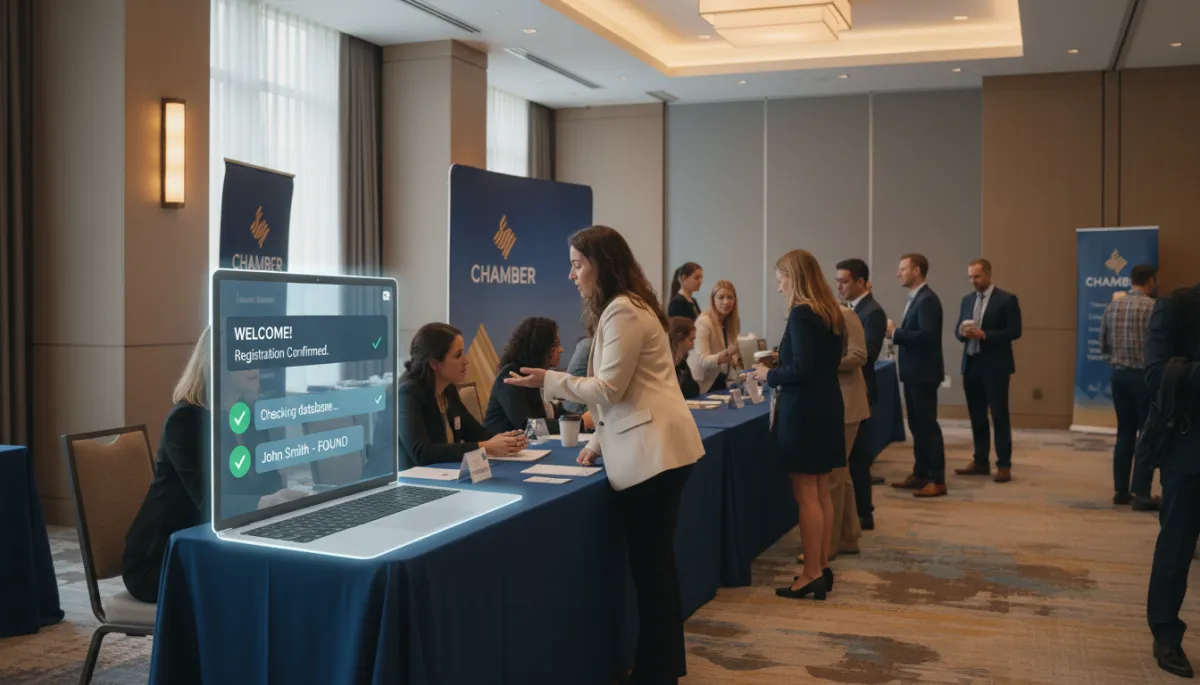
AI-driven registrations reduce manual data entry while keeping attendee information accurate and complete.
Instead of chasing down RSVPs and correcting misspelled names, your staff can focus on sponsorship sales, partner outreach, and high-impact programming. The AI receptionist becomes your first-line event coordinator—promoting, registering, and informing—so your team can concentrate on designing events that actually move the needle for your business community.
3. Turning Your FAQ Library into a Live, Conversational Assistant
Most Chambers already maintain FAQ pages, member guides, and program brochures. The problem is that busy business owners rarely dig through them. An AI customer service agent can transform this static content into a live, conversational FAQ that responds in plain language, 24/7, on any device.
- It can answer frequently asked questions about membership tiers, dues, renewal timelines, and benefits eligibility instantly, without forcing members to navigate multiple pages.
- It can explain programs—such as leadership academies, young professionals groups, or small business grants—in clear, concise terms tailored to the member’s situation.
- It can provide step-by-step guidance on processes like joining the Chamber, updating member profiles, or submitting news for your newsletter.
Because the AI is trained on your own documents and website, it reflects your policies and your voice. When information changes—new membership rates, updated bylaws, revised event policies—you update the source documents once, and the AI immediately uses the latest version. This eliminates outdated PDF attachments, conflicting answers, and internal confusion about “which document is correct.”
4. Automating Follow-Ups and Member Nurture
Chambers lose opportunities not because they lack interest or intent, but because follow-up falls through the cracks. Staff are juggling renewals, board meetings, advocacy campaigns, and events. An AI-powered customer service agent can run a disciplined, automated follow-up process in the background, ensuring every interaction is acknowledged and every lead is nurtured.
- Post-inquiry follow-up: When someone asks about joining, the AI can send a tailored follow-up email or text with membership details, benefits relevant to their industry, and a direct link to join or schedule a call with your team.
- Event follow-up: After events, the AI can distribute thank-you messages, share slides or recordings, request feedback, and suggest the next relevant program or committee to participate in.
- Renewal nudges: As memberships approach expiration, the AI can send reminders, answer renewal questions, and route at-risk accounts to staff for personal outreach when needed.

Automated, timely follow-ups protect renewals and convert more prospects without adding staff workload.
This automated follow-up does more than save time. It creates a consistent experience where every prospect and member feels seen and supported. Your staff can then step in where it matters most—major investors, at-risk key accounts, and strategic partners—confident that the rest of your membership is receiving timely, professional communication from your AI assistant.
5. Freeing Staff for High-Value, High-Impact Work
Your team’s highest and best use is not answering “What time is the luncheon?” ten times a day. It is building relationships, advocating for business, designing programs, and securing funding. An AI receptionist and customer service agent creates the time and mental bandwidth your staff need to operate at that strategic level consistently.
- Executives can spend more time with top investors and community leaders, rather than triaging email.
- Membership teams can focus on targeted recruitment and retention strategies, instead of processing forms and answering routine questions.
- Event staff can concentrate on program quality, sponsorship value, and attendee experience, not logistics emails.

AI frees leadership teams to spend more time on strategy, advocacy, and investor engagement.
The result is not just time savings; it is organizational elevation. When routine service is handled reliably by AI, you can reframe staff roles around growth, innovation, and impact. You are no longer choosing between excellent service and strategic work. You can deliver both, at scale, with the same headcount.
Practical Steps to Implement AI at Your Chamber
Moving from concept to implementation does not require a large IT project. It requires clarity about where AI can create the most immediate value. Start with a focused, low-risk deployment and expand as you see results.
- Identify your top three repetitive workflows. For most Chambers, these are membership inquiries, event questions, and basic business resource questions. Quantify how many emails or calls they generate per week and how much staff time they consume.
- Gather your core documents. Collect membership guides, FAQs, event policies, program descriptions, and key website pages. These will form the knowledge base your AI uses to respond accurately in your voice.
- Deploy AI on one primary channel first. This might be your website chat, a dedicated email address, or SMS for event reminders. Monitor the quality of responses, refine the content, and then expand to additional channels once you are satisfied.
- Set clear escalation rules. Define when the AI should hand a conversation to a human—such as complaints, media inquiries, or complex policy questions—and ensure your staff receive those escalations with full context.
- Measure impact. Track metrics like response time, number of inquiries handled by AI, staff hours saved, event registration conversion rates, and member satisfaction. Use these data to inform your next phase of automation.
The key is to treat AI as a managed service, not a one-time tool. As your Chamber’s priorities and programs evolve, you will update the AI’s knowledge base and workflows. Over time, it becomes a deeply embedded part of how you deliver member value every day.
Addressing Common Concerns from Chamber Leaders
Directors and executives often raise the same questions when considering AI. They are valid and manageable with the right approach.
- “Will this feel impersonal?” Properly configured, an AI receptionist uses your Chamber’s tone, welcomes members by name, and provides specific, helpful answers. For routine questions, members care more about speed and clarity than whether a human typed the response. For sensitive issues, escalation to staff is built in.
- “Is our data secure?” Leading AI solutions offer enterprise-grade security, role-based access, and clear data handling policies. You control what information the AI can access and how it is used. Work with vendors that understand nonprofit and public-sector standards.
- “Will my staff resist this?” When you frame AI as a tool that removes low-value tasks and gives staff more time for meaningful work, most teams welcome it. Involve them in defining which tasks to automate and how escalations should work. Their input will improve adoption and outcomes.

Clear governance and staff involvement ensure AI enhances your culture instead of disrupting it.
The Strategic Advantage for Forward-Thinking Chambers
Chambers that adopt AI receptionists and customer service agents gain more than efficiency. They gain strategic flexibility. With routine service automated, you can scale programs without proportional increases in staff workload. You can respond to surges in demand—such as during crises, policy changes, or major economic developments—without sacrificing member experience. And you can position your Chamber as a modern, tech-enabled leader in your region.
Members notice when their Chamber responds quickly, communicates clearly, and makes it easy to engage. Prospective members notice when inquiries are answered promptly and professionally. Investors notice when staff are available for strategic conversations instead of buried in their inbox. AI is not a gimmick; it is an operational foundation that supports the level of service and impact you are already striving to deliver.
Conclusion: Put AI to Work for Your Members and Your Team
An AI receptionist and customer service agent can handle routine member inquiries, manage event registrations, deliver accurate FAQ responses, and run consistent follow-ups automatically. For Chambers of Commerce, this is not a theoretical future—it is a practical, available toolset that directly addresses today’s staffing and service pressures. The payoff is clear: faster answers for members, more registrations and renewals captured, and staff time redirected to the high-value work only they can do.
As a director or executive, your responsibility is to position your Chamber for the next decade, not just the next quarter. AI is now a core component of that strategy. Start with one or two high-impact workflows, prove the value, and expand. The Chambers that act now will define the standard of member service and operational excellence in their regions. The tools are ready. The question is whether you are prepared to put them to work for your organization and your business community.
