
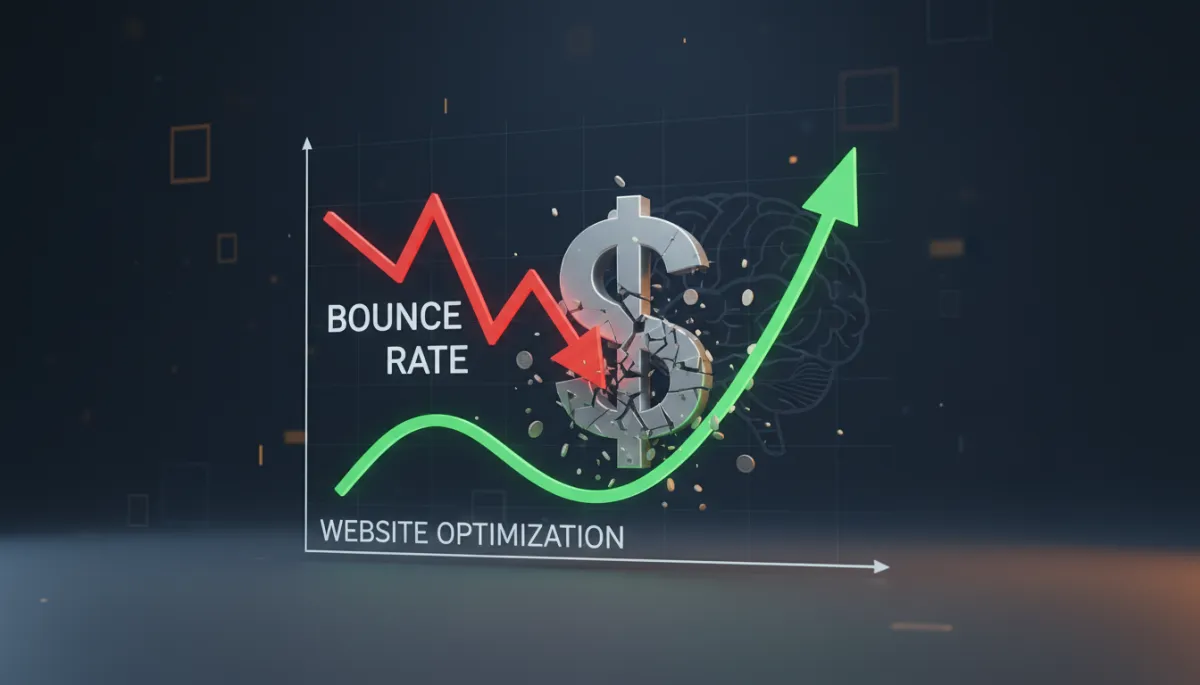
Reduce Bounce Rate to Boost Revenue by $10,000+
Analytics, Bounce Rate, Revenue Optimization
Your Website Bounce Rate Is Costing You $10,000+ Monthly — Here’s How To Stop The Bleed
Your bounce rate is not a vanity metric — it is a direct line item on your profit and loss statement. In this guide, you will see how high bounce rates quietly erase five‑figure monthly revenue, what drives visitors to leave, and the exact optimization process that turns those lost sessions into paying customers.
Your Bounce Rate — The Silent Profit Killer Most Teams Ignore
Most professionals glance at bounce rate during monthly reporting, then move on. It sits beside sessions and page views — a percentage that seems interesting, but not urgent. That mindset is expensive. A high bounce rate means the majority of visitors leave without clicking, scrolling, or converting. You paid to acquire those visitors, yet they exit before your website has a chance to sell, educate, or qualify them. The cost compounds every single day.
When you translate bounce rate into revenue impact, it stops being an abstract metric and becomes a hard‑number business problem. Fixing it is not about chasing “perfect” analytics — it is about reclaiming the revenue your website is already capable of generating, but currently leaves on the table through preventable visitor behavior patterns and poor optimization choices.
The Real Cost Of Your Bounce Rate — Turning Percentages Into Dollars
To understand what bounce rate is costing you, you must connect four numbers — traffic volume, bounce rate, conversion rate, and average order value or lead value. The math is straightforward, yet few teams perform it with discipline. Assume your website receives 20,000 visits per month, has a 68% bounce rate, converts at 3.5%, and generates an average of $220 per transaction or qualified lead. On paper, this can look acceptable. In reality, it is leaking thousands in unrealized revenue every month.
Out of 20,000 visits, a 68% bounce rate means 13,600 visitors leave after a single page. Only 6,400 continue. At a 3.5% conversion rate, you capture 224 conversions worth roughly $49,280. Now, reduce bounce rate to 40% — a realistic target with focused optimization. You now retain 12,000 visitors, not 6,400. At the same 3.5% conversion rate, that is 420 conversions and $92,400 in revenue. The difference — $43,120 — is the monthly revenue upside created purely by changing how many people stay long enough to act. No extra ad spend, no new campaigns, just better use of the traffic you already own.
📌 Key Takeaway: A “small” bounce rate improvement — from the high 60s to around 40% — can unlock tens of thousands in monthly revenue without increasing traffic volume.
Why Visitors Flee — The Behavioral Science Behind The Bounce
Bounce rate is ultimately a measure of visitor behavior — it tells you how effectively your website meets the expectations and intent of people arriving from search, ads, email, and social. When those expectations are violated, visitors leave. Through analysis of hundreds of professional websites across B2B, SaaS, and high‑value services, four dominant bounce triggers appear repeatedly, regardless of industry or audience sophistication.
1. The Critical 3‑Second Window For First Impressions
Visitors decide whether to stay or leave in seconds — often before they consciously register what your page says. If your site loads slowly, shifts layout while loading, or presents a cluttered hero section, visitors experience friction before they encounter your value proposition. In that moment, leaving feels easier than investing attention. This is especially true for busy professionals — they scan quickly, make snap judgments, and rarely grant a second chance to a site that feels confusing or untrustworthy on first contact.
Optimizing this 3‑second window is not about design trends — it is about clarity, stability, and speed. Your above‑the‑fold content must answer three questions immediately: what you offer, who it is for, and what to do next. Anything that delays or distracts from those answers — auto‑playing video, intrusive pop‑ups, vague headlines — inflates bounce rate and suppresses revenue.
2. Mobile Experience Abandonment And The Cost Of Friction
For many businesses, 55–70% of traffic now arrives on mobile devices. Yet a surprising number of sites are still designed around desktop assumptions — dense navigation menus, tiny tap targets, slow‑loading hero images, and forms that feel impossible to complete on a phone. Mobile visitors are impatient by necessity — they are often multitasking, on the move, or in between meetings. Every additional second of load time and every unnecessary field in a form increases the likelihood of a bounce and, by extension, lost revenue.
When you review your analytics by device category, you often see a stark pattern — mobile bounce rates 15–25 percentage points higher than desktop. That gap represents a structural weakness in your customer acquisition funnel. Closing it through targeted mobile optimization — compressed assets, simplified navigation, and frictionless calls to action — directly improves both visitor behavior and financial performance.
3. Content–Expectation Mismatch Across Traffic Sources
Bounce rate spikes when visitors feel misled — even subtly. This typically occurs when there is a disconnect between the promise made in a search result, ad, or email, and the content on the landing page. If your Google Ads promise a specific solution, but the click leads to a generic homepage, visitors feel they have arrived in the wrong place. If a blog headline suggests a tactical how‑to, but the article turns into a sales pitch, readers exit. The underlying issue is misaligned intent, not “bad” traffic.
Aligning entry points with visitor expectations is one of the fastest ways to reduce bounce rate. Each major campaign — paid or organic — deserves a dedicated landing experience that mirrors the language, promise, and intent that brought the visitor in. When message match is strong, visitor behavior shifts — people scroll further, engage more deeply, and are significantly more likely to convert, which compounds your return on every marketing dollar spent.
4. Missing Trust Signals At High‑Value Decision Points
High‑intent visitors will not move forward if they sense risk — no matter how compelling your offer is. When pages lack visible trust signals, bounce rate climbs, particularly on pricing, checkout, and lead‑capture pages. Missing or outdated testimonials, absent security badges, vague privacy assurances, and anonymous “About” pages all trigger hesitation. Professionals responsible for budgets or procurement are trained to avoid risk — if your site does not clearly communicate credibility, they leave and choose a safer alternative.

When teams align analytics with visitor intent, bounce rate becomes a precise revenue lever.
The Hidden Multiplier Effect — How Bounce Rate Erodes Marketing ROI
High bounce rates do more than waste individual visits — they quietly undermine your entire marketing ecosystem. Every campaign, from paid search to webinars, ultimately routes through your website. When visitors bounce, you do not just lose a single conversion opportunity — you weaken audience quality for retargeting, distort attribution models, and mislead your team about which channels are truly effective. This creates a feedback loop where budgets are reallocated based on incomplete or skewed data, compounding the financial damage over time.
Conversely, when you lower bounce rate, you increase the yield of every acquisition channel simultaneously. More visitors move deeper into your funnel, more contacts are captured, and more data is generated about what actually drives revenue. The cost per acquisition decreases, lifetime value improves, and your forecasting becomes more accurate. This is why leading organizations treat bounce rate optimization as a core lever in their revenue strategy — not a peripheral UX project.
Case Study — How A B2B Firm Recovered $13,450 Monthly By Fixing Bounce Rate
A mid‑market B2B services company approached our team after experiencing stagnant revenue despite rising marketing spend. Their website attracted approximately 18,000 monthly visits, mainly from paid search and industry content partnerships. On the surface, their metrics seemed acceptable. Deeper analysis revealed a critical issue — an overall bounce rate of 71%, with some high‑intent landing pages exceeding 80%. The company was effectively paying to send qualified prospects to a site that repelled them within seconds.
Problem 1 — Mobile Experience Breakdown On High‑Intent Pages
Over 60% of their traffic was mobile, yet key pages were built with a desktop‑first mindset. Critical service detail pages loaded in more than 11 seconds on 4G connections, with large hero images and uncompressed scripts blocking rendering. Forms were difficult to complete on smaller screens, and tap targets were too close together. Mobile bounce rates exceeded 82% on some of the most valuable entry points — a clear indicator that visitor behavior was driven by frustration, not lack of interest.
Problem 2 — Contextual Disconnect Between Ads And Landing Pages
Their paid search campaigns targeted specific, high‑intent queries — detailed service terms and industry‑specific language. However, most of this traffic was directed to a generic overview page that tried to speak to every audience segment at once. The result was a content–expectation mismatch. Visitors arrived expecting a focused solution and instead encountered broad, unfocused messaging. Heatmaps showed minimal scroll depth and rapid exits, confirming that the disconnect was driving bounces and eroding ad ROI.
Problem 3 — Weak Trust Signals On Conversion‑Critical Screens
For a firm selling high‑value contracts, trust should have been central to the experience. Instead, testimonials were buried, case studies were difficult to find, and there were no visible security badges or guarantees near forms. Decision‑makers arriving on the “Request a Proposal” page saw a long, intrusive form with no reassurance about how their information would be used. Analytics showed a sharp bounce spike on this step, even among visitors who had engaged deeply with prior content — a clear signal that missing trust elements were blocking revenue.
The Implementation Plan — A Focused, 5‑Week Optimization Sprint
We structured the engagement around bounce rate reduction as a measurable objective, not a vague redesign. First, we instrumented advanced analytics — event tracking, scroll depth, and session recordings — to map visitor behavior across the top 20 entry pages. Next, we prioritized changes that combined high bounce rates with strong revenue potential. The work focused on four pillars — mobile speed optimization, message alignment, UX simplification, and trust amplification at conversion points.
On mobile, we compressed and resized imagery, deferred non‑essential scripts, and simplified layouts to reduce load times from 11+ seconds to under 3 seconds on key pages. For traffic alignment, we created dedicated landing pages for each high‑intent ad group, mirroring the language and promises used in the ads. We streamlined forms, reduced fields, and added clear privacy statements. Finally, we surfaced client logos, testimonials, and case study highlights above the fold on service and proposal pages to reassure visitors at critical decision moments.
The Results — Lower Bounce, Healthier Pipeline, Measurable Revenue Lift
Within 60 days of deployment, the firm’s overall bounce rate dropped from 71% to 39%. Mobile bounce rate on high‑value pages fell by more than 30 percentage points. Average session duration increased by 64%, and the number of visitors reaching proposal and consultation forms more than doubled. Most importantly, qualified inbound opportunities increased by 47% month over month, translating into an additional $13,450 in predictable monthly revenue — without any increase in ad spend or content production volume.
💡 Pro Tip: Treat bounce rate optimization as a time‑boxed, high‑impact sprint. Focus on your top entry pages and highest‑value conversion paths first — not on cosmetic site‑wide changes.
The 5‑Step Process To Fix Your Bounce Rate — Without Guesswork
Effective bounce rate reduction is systematic — not a collection of random design tweaks. The following five‑step process has been tested across industries and revenue models. It connects bounce rate, visitor behavior, and website optimization into a single, disciplined framework you can apply to your own site.
Step 1 — Diagnose With Advanced Analytics, Not Hunches
Start by identifying where bounce problems are concentrated. Standard analytics will show you bounce rate by page, device, and channel, but you need more context. Implement event tracking to capture clicks, scroll depth, and form interactions. Use heatmaps and session recordings to observe real visitor behavior. Look for patterns — pages where visitors rarely scroll, exit quickly, or hesitate over specific elements. These insights tell you whether people are leaving because of speed, clarity, relevance, or trust issues, and they prevent you from optimizing the wrong thing.
Step 2 — Prioritize Page‑Specific Speed And Stability Improvements
Do not chase a perfect global performance score — instead, prioritize the specific entry pages that receive the most traffic and generate the most revenue. Audit each for load time, layout shifts, and mobile usability. Compress and properly size images, remove unused scripts, and defer non‑critical resources so that the core content appears almost instantly. Your objective is simple — ensure visitors see a stable, readable, and relevant hero section within the first few seconds, regardless of device or connection speed. This single change can produce noticeable drops in bounce rate within days of deployment.
Step 3 — Align Entry Points With Visitor Intent And Expectations
Map your traffic sources to your landing experiences. For each major campaign — paid search, paid social, email, and organic content — ask a direct question: “Does the landing page deliver exactly what the visitor expects after seeing this ad, subject line, or search result?” If the answer is anything less than a clear yes, you have an alignment problem. Create or refine dedicated landing pages that mirror the language and promise of each source. Clarify headlines, tighten messaging, and remove distractions that are not relevant to the specific intent that brought the visitor in. This alignment reduces cognitive dissonance and keeps visitors engaged long enough to convert.
Step 4 — Optimize First Impressions And Above‑The‑Fold Content
With speed and alignment in place, focus on what visitors actually see first. The above‑the‑fold section must clearly communicate your offer, your audience, and your next step. Replace vague headlines with benefit‑driven statements. Use subheadlines to address the primary pain point or desired outcome of your ideal visitor. Ensure your primary call to action is visible without scrolling and that it uses specific, action‑oriented language. Support this with a single, relevant visual — not a generic stock image — that reinforces your message. The goal is to reduce cognitive load so visitors immediately understand why they should stay.
Step 5 — Build A Culture Of Continuous Testing And Refinement
Bounce rate optimization is not a one‑time project — visitor behavior shifts as markets, devices, and expectations evolve. Establish a simple A/B testing program focused on high‑impact variables: headlines, hero imagery, call‑to‑action placement, form length, and trust signal prominence. Run tests long enough to achieve statistical confidence, then document what works and roll it out to similar pages. Over time, this creates a compounding effect — each incremental improvement in bounce rate and conversion rate builds on the last, steadily increasing the revenue your website produces from the same or lower traffic volume.
Calculate Your Bounce Rate’s Financial Impact — A Simple Framework
To secure buy‑in from stakeholders, you must translate bounce rate into revenue terms. Use this straightforward framework with your own numbers:
Identify monthly sessions to your top 5–10 entry pages.
Note current bounce rate, conversion rate, and average revenue per conversion.
Model a conservative bounce rate improvement — for example, a 20–30% relative reduction.
Keep conversion rate and traffic constant, and calculate the additional conversions and revenue produced by the extra engaged visitors.
When you present this analysis, you transform bounce rate from an abstract percentage into a forecastable revenue lever. Decision‑makers can see, in dollars, what a reduction in bounce rate means for pipeline, bookings, or sales — making investment in website optimization far easier to justify and prioritize.
Why Most Bounce Rate Fixes Fail — And How To Ensure Yours Works
Many organizations attempt to tackle bounce rate with surface‑level changes — new color palettes, different stock photos, or a redesigned navigation bar. These efforts may look impressive, but they rarely produce meaningful shifts in visitor behavior or revenue impact. The root cause is simple — the changes are driven by opinion, not data. Without a clear understanding of why visitors are leaving, teams end up optimizing what is easy to change rather than what is actually causing bounces.
To avoid this trap, anchor every optimization decision in observed behavior and measurable outcomes. Before altering a page, define a specific hypothesis — for example, “clarifying the hero message for mobile visitors will reduce bounce rate on this page by 15%.” Implement changes in a controlled way, monitor results, and compare against your baseline. This disciplined approach ensures your bounce rate initiatives produce real, compounding gains rather than temporary cosmetic improvements that fail to move revenue.
Your Next Step — Turn Bounce Rate Into A Competitive Advantage
If your website’s bounce rate is sitting in the 60–80% range — especially on high‑intent pages — you are likely leaving $10,000 or more in monthly revenue unrealized. The good news is that this is one of the most controllable levers in your digital strategy. By understanding visitor behavior, aligning expectations with content, and implementing targeted website optimization, you can convert more of your existing traffic into qualified leads, opportunities, and sales — without increasing your media budget.
Treat bounce rate as a financial metric, not just an analytics curiosity. Run the revenue calculation for your own site, identify your highest‑impact pages, and commit to a focused optimization sprint. When you do, you will see bounce rate fall, engagement rise, and revenue grow — proving that the visitors you already attract are far more valuable than your current numbers suggest.
