

Simplify Your Day: Achieve More by Doing Less
Productivity, Personal Growth
The Art of Doing Less: How to Accomplish More by Simplifying Your Day
Modern life rewards busyness, but not always progress. By learning to do less, more intentionally, you can reclaim your time, protect your energy, and finally move the projects that truly matter from “someday” to “done.”
Why Doing Less Is Not Laziness
Many people secretly equate “doing less” with a lack of ambition. In reality, the opposite is true. Doing less is about strategy, not slacking. It means choosing your efforts carefully so that every hour of work has a purpose, instead of scattering your attention across a dozen half-finished tasks that never quite move the needle.
Think of your time and energy as finite resources. When you say yes to every request, meeting, and idea, you dilute those resources until even the most important work is starved. Doing less is the discipline of saying no to the noise so you can say a powerful yes to the few things that create real impact in your career, business, or personal life.
Step 1: Decide What Actually Matters
You cannot do less until you know what deserves more. Start by asking yourself three simple questions:
If I could only make progress on three things this month, what would they be?
Which tasks, if completed, would make other tasks easier or unnecessary?
What do I keep postponing even though I know it is important?
Your answers form the backbone of a simpler, more focused schedule. These are your high-value priorities. Everything else is either support work, background noise, or someone else’s agenda. Treat those priorities as non‑negotiable appointments with your future self, not optional extras squeezed in when you are already exhausted.
Step 2: Ruthlessly Edit Your To‑Do List
Once your priorities are clear, look at your current to‑do list with a critical eye. Instead of asking, “Can I fit this in?” ask, “Should I be doing this at all?” Every task can usually be:
Deleted – because it does not support your goals or adds only cosmetic progress.
Delegated – because someone else can do it just as well, or better.
Deferred – because it matters, but not right now.
Done by you – because it directly advances a key priority.
💡 Pro Tip: If a task has been on your list for weeks with no real consequence, experiment with deleting it. Most of the time, nothing breaks.
Step 3: Design a Simpler Daily Rhythm
A simplified life is built day by day. Instead of cramming your calendar from morning to night, create a gentle rhythm with clear zones of focus. A straightforward structure could look like this:
Morning: Deep work only. One to two uninterrupted blocks dedicated to your most important project, with notifications off and email closed.
Midday: Collaboration and communication. Meetings, calls, and messages grouped together instead of scattered throughout the day.
Afternoon: Light tasks and review. Admin work, small errands, and a short planning session for tomorrow.
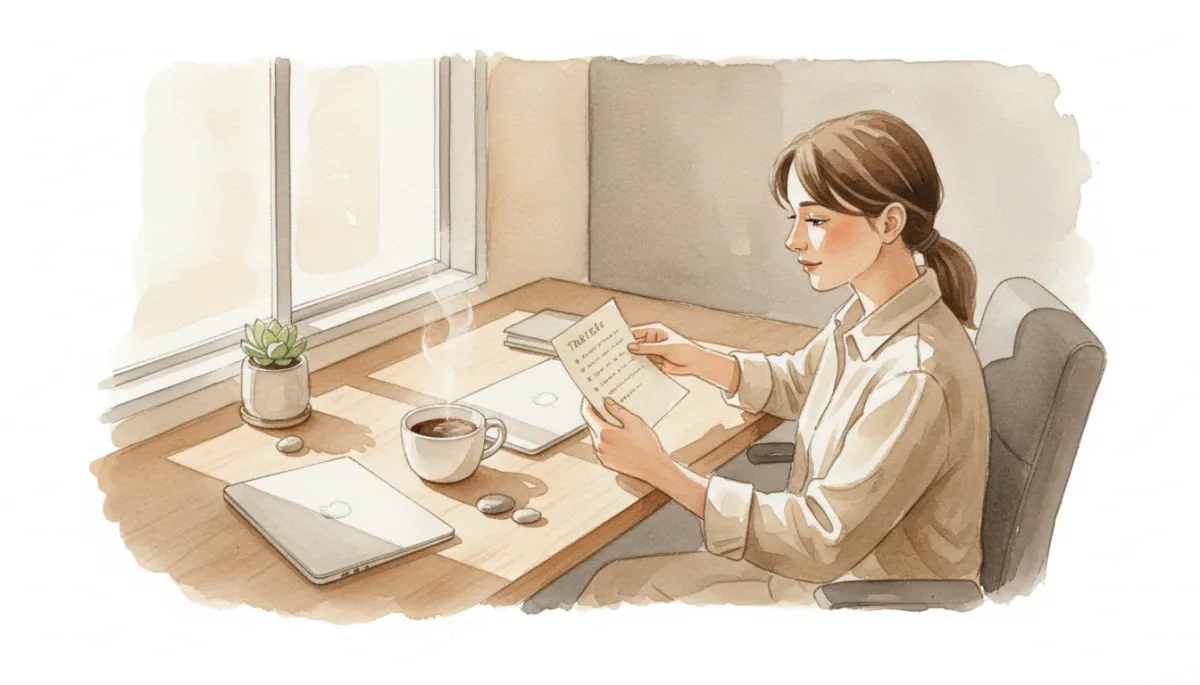
A short, focused daily plan often outperforms an ambitious, crowded one.
Step 4: Protect Your Boundaries Without Guilt
Simplifying your day will not last if you feel guilty every time you say no. Remember that every yes is also a no—usually to your own priorities, health, or relationships. It is far more honest to decline a request than to accept it and deliver half‑hearted work weeks late.
You do not owe anyone a long explanation. A simple, respectful line such as, “I’d love to help, but I don’t have the capacity to do this well right now,” protects your time while honoring the other person. Over time, people learn to trust your boundaries—and you begin to trust yourself to keep them.
Step 5: Redefine Success as Sustainable Progress
The final shift is internal. Instead of measuring success by how much you squeezed into a single day, measure it by how consistently you move the right things forward. A calm hour of focused work, repeated most days, beats a frantic ten‑hour sprint followed by burnout and avoidance.
When you practice the art of doing less, you start to notice something powerful: life feels lighter, yet your results improve. Projects finish. Ideas move. You have room to think, to rest, and to enjoy the people and experiences that make all this effort worthwhile. That is not laziness. That is a life designed on purpose.
