

Maximize Lead ROI: Stop Losing Paid Leads Now
Sales, Lead Management, Small Business Growth
How to Stop Losing Leads You Already Paid For
You work hard and invest real money to generate leads: ads, networking, referrals, sponsorships, SEO, events. Yet many small businesses quietly leak those leads before they ever become customers. This article explains why that happens and how to fix it with practical, realistic systems that do not require a giant sales team or complex software.
The Silent Profit Killer: Leads That Slip Through the Cracks
Most small business owners focus their energy on getting more leads: more clicks, more calls, more form fills. Yet the fastest way to grow revenue is often not more leads, but better follow-up on the leads you already have. Every time someone fills out a form, calls your office, or replies to an email campaign, you have paid for that opportunity in time, money, or both. When that lead is ignored, delayed, or mishandled, the cost is much higher than it appears at first glance.
1. The Hidden Cost of Poor Lead Follow-Up
What a “Lost Lead” Really Costs You
Consider a simple example. Imagine you spend $2,000 per month on marketing that generates 100 leads. On paper, your cost per lead is $20. If you only follow up properly with half of those leads, your real cost per usable lead is not $20—it is $40. The other 50 leads might as well have never existed, because they never received a meaningful response from your business.
Now add in the potential revenue. If your average customer is worth $1,000 and you lose even 10 qualified leads per month due to poor follow-up, that is $10,000 in missed revenue every month. Over a year, that is $120,000 in sales that could have been yours without spending a single extra dollar on advertising—just by following up better.
The Opportunity Cost You Do Not See on the P&L
Poor lead follow-up also creates hidden opportunity costs that never show up directly in your profit and loss statement:
Lost lifetime value: Many customers would buy from you repeatedly over several years. Losing one sale often means losing a long-term relationship and referrals that would have followed.
Damaged reputation: When someone inquires and never hears back, they rarely complain; they simply move on—and sometimes tell others that your business is unresponsive or disorganized.
Demoralized team: Staff can become discouraged when they see leads coming in but lack a clear system to convert them, leading to wasted effort and lower morale.
📌 Key Takeaway: Every lead you do not follow up with quickly and consistently increases your real marketing costs and reduces your long-term revenue potential.
Why “We’re Too Busy” Is an Expensive Excuse
It is common for small business owners to say, “We are just too busy to follow up with everyone.” The reality is that being too busy to follow up is equivalent to saying, “We are too busy to close more sales.” Often, the busyness comes from handling work that lower-value customers bring in, while higher-value opportunities are quietly ignored because they require a structured follow-up process rather than reactive responses.
2. Common Reasons Businesses Lose Leads
If you recognize yourself in any of the patterns below, you are not alone. These issues are extremely common in small businesses—and they are all fixable with the right systems and habits.
Reason #1: Slow Response Time
In today’s world, prospects expect a quick response—often within minutes, not days. Studies across multiple industries show that contacting a new lead within the first hour dramatically increases your chances of reaching them and scheduling a conversation. Waiting 24–48 hours can cut your conversion rate in half or more.
For small businesses, slow responses usually happen because:
The owner is in the field, on job sites, or serving customers and cannot check email or answer calls immediately.
There is no clear responsibility—everyone assumes someone else will call the lead back.
Leads come in through multiple channels (website, Facebook, phone, walk-ins), and no one is monitoring them centrally.

Missed calls and delayed replies quietly drain marketing ROI and future revenue.
Reason #2: No Central System to Track Leads
Many small businesses rely on a patchwork of notebooks, spreadsheets, email inboxes, and sticky notes to track leads. This might feel manageable when you have only a few inquiries per week, but as volume grows, it becomes impossible to know:
Who has been contacted and who has not
What was discussed in previous conversations
Which leads are ready to buy soon versus those who need more time
Without a central system, leads get lost in email threads, follow-up tasks are forgotten, and there is no clear picture of your sales pipeline. You might feel like you have a “sales problem” when in reality you have a “tracking problem.”
Reason #3: No Nurture Process for “Not Ready Yet” Leads
Not every lead is ready to buy immediately. Some are comparing options. Others are waiting for budget approval, a specific date, or a life event. When there is no structured nurture process, these leads simply fade away after one or two conversations, even though they might have been ideal customers a few weeks or months later.
Common signs that your business lacks a nurture process include:
You rarely follow up more than once or twice if a prospect does not respond immediately.
You do not have pre-written emails or messages that educate and build trust over time.
Your only communication with leads is an initial quote or proposal—then silence.
Reason #4: Inconsistent Follow-Up Habits
Even when there is an intention to follow up, it often depends on the energy and memory of the owner or one key team member. On busy days, follow-up gets pushed aside. On quieter days, there is more effort—but by then, some leads have gone cold. Inconsistent follow-up means results are unpredictable, making it difficult to plan and grow with confidence.
Reason #5: No Clear Next Step for the Prospect
Sometimes leads are lost not because you failed to respond, but because your response did not make the next step obvious and easy. If your emails or calls end with vague phrases like “Let me know if you have any questions,” prospects may not know what to do or may not feel motivated to act. Clear calls to action—such as scheduling a call, confirming a quote, or choosing a package—significantly improve conversion rates.
💡 Pro Tip: Ask yourself, “If I were the prospect reading this email or text, would I know exactly what to do next and why I should do it now?”
3. Practical Strategies to Plug the Leaks
The good news is that you do not need a large sales department or enterprise software to fix these problems. With a few well-chosen tools and some simple processes, you can dramatically improve your follow-up and win more business from the leads you already generate.
Strategy #1: Put a CRM at the Center of Your Lead Management
A Customer Relationship Management (CRM) system is simply a central place to store information about your leads and customers. For small businesses, a good CRM does three crucial things:
Captures every lead in one place, regardless of how they contact you (website, phone, social media, referrals).
Tracks every interaction—calls, emails, meetings—so you always know the history of each relationship.
Helps you prioritize and schedule follow-up tasks, so nothing falls through the cracks.
You do not need a complex or expensive CRM to see benefits. Many small-business-friendly tools are affordable, easy to set up, and integrate with common platforms such as Gmail, Outlook, and website forms. The key is to commit to using one system consistently rather than scattering lead information across multiple tools and documents.
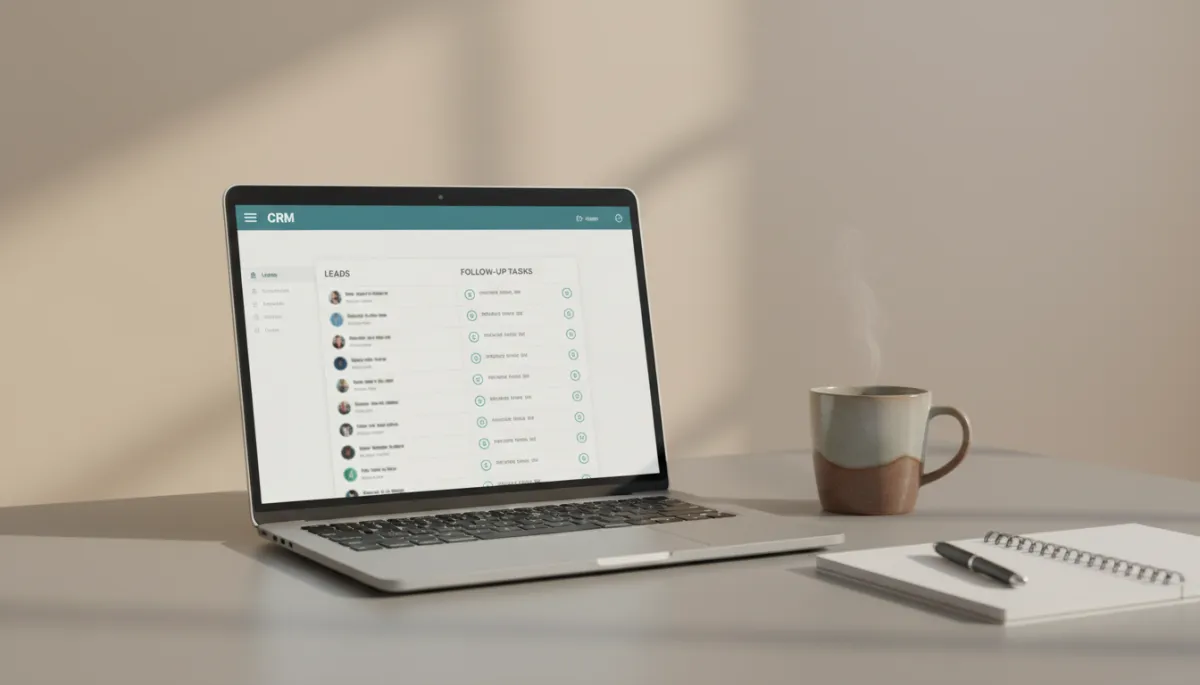
A basic CRM turns scattered inquiries into an organized, trackable sales pipeline.
How to Choose a CRM That Fits a Small Business
When evaluating CRM options, focus on features that directly support better follow-up rather than long lists of advanced capabilities you may never use. For most small businesses, the following features are sufficient:
Easy contact capture from your website forms and email
Ability to create tasks and reminders for follow-up calls and emails
Simple pipeline stages (for example: New Lead, Contacted, Proposal Sent, Won, Lost)
Basic email templates and automated sequences (more on this shortly)
📌 Key Takeaway: The best CRM for your small business is the one you and your team will actually use every day, not the one with the longest feature list.
Strategy #2: Use Automation to Respond Instantly and Consistently
Automation does not replace personal contact; it ensures that no lead is left waiting in silence. By setting up a few automated steps, you can acknowledge every inquiry immediately and set expectations for what happens next, even when you are busy or out of the office.
Automated Acknowledgment Emails and Texts
When someone fills out a form on your website or sends an email inquiry, an automatic response should:
Thank them for reaching out and confirm that you received their message.
Let them know when they can expect a personal response (for example, “within one business day” or “today before 5 p.m.”).
Offer a simple next step, such as scheduling a call using an online calendar link.
This basic automation alone can set you apart from competitors who may take hours or days to reply, if they reply at all. Prospects feel reassured that you are organized and attentive, even before you speak with them directly.
Automated Reminders for Your Team
Automation can also support your internal process. For example, when a new lead is created in your CRM, the system can automatically:
Assign it to a specific team member responsible for follow-up.
Create a task to call the lead within a set timeframe (such as 2 hours).
Send reminder notifications if the task is not completed on time.
These small automations act like a safety net, making it much harder for leads to be forgotten when your day gets hectic.
Strategy #3: Build Simple, Effective Follow-Up Sequences
A follow-up sequence is a pre-planned series of touchpoints—emails, calls, or texts—that guide a prospect from initial inquiry to decision. Instead of improvising each time, you create a repeatable process that any team member can follow. This makes your results more predictable and your workload more manageable.
Example: A 7-Day New Lead Follow-Up Sequence
Here is a straightforward sequence many small businesses can adapt:
Day 0 – Immediate: Automatic email or text confirming receipt of the inquiry and offering a scheduling link or promising a call soon.
Day 0 – Within 2 hours: Personal phone call or personalized email addressing their specific request or question.
Day 1: Follow-up email summarizing the conversation (if you connected) or a second attempt to reach them (if you did not), plus a short FAQ or helpful resource.
Day 3: Brief check-in by email or text: “Just wanted to make sure you received my previous message and to see if you have any questions.”
Day 5: Share a testimonial, case study, or example relevant to their situation to build trust and demonstrate results.
Day 7: “Last call” message: politely letting them know you will close the file for now but that they can reach out anytime if the timing becomes right.
Parts of this sequence can be automated (such as the emails), while calls and personalized messages remain human. The key is to have the steps defined so that you are not starting from scratch with every new inquiry.
Nurture Sequences for “Not Now” Leads
For leads that are interested but not ready to buy, create a longer-term nurture sequence that might extend over several weeks or months. This could include:
Educational emails that answer common questions and address typical concerns
Occasional check-ins to see if their situation has changed or if they are ready to move forward
Invitations to webinars, events, or special promotions that might prompt a decision
By staying in touch in a helpful, non-pushy way, you remain top of mind so that when the timing is right, your business is the first one they think of.
Strategy #4: Standardize How Your Team Handles Leads
Even the best tools will not help if everyone on your team handles leads differently. Creating simple, written standards for lead handling ensures that every prospect receives a professional and consistent experience, regardless of who answers the phone or replies to the email.
Define Roles and Response Times
Start by answering these questions:
Who is responsible for monitoring new leads each day?
How quickly should each type of lead be contacted? (For example, “within 1 hour during business hours.”)
What happens if the primary person is unavailable? Who is the backup?
Document these expectations and review them with your team, so everyone understands the importance of prompt, professional follow-up and how it directly impacts revenue and job security.
Provide Scripts and Templates
Many team members avoid follow-up simply because they are unsure what to say. Providing simple scripts and email templates removes this barrier and ensures that your messaging is clear and on-brand. For example:
A script for answering new inquiry calls and collecting essential information
A template for sending a quote or proposal with a clear next step
A template for following up after a quote has been sent, including a specific call to action
💡 Pro Tip: Keep scripts and templates short, friendly, and focused on helping the prospect make a decision, not pressuring them.
Strategy #5: Measure and Improve Your Follow-Up Performance
You cannot improve what you do not measure. Once you have a basic CRM and follow-up process in place, track a few key numbers each month:
Number of new leads generated
Percentage of leads contacted within your target response time
Conversion rate from lead to customer
Average revenue per new customer
Even simple tracking can reveal powerful insights. For example, you might discover that leads contacted within two hours convert at 30%, while those contacted after 24 hours convert at only 10%. That information justifies investing in better processes, tools, or staffing to respond faster—because the return is clear and measurable.
4. Turning Lost Leads into a Growth Opportunity
Improving lead follow-up is not just about fixing problems; it is about unlocking growth that is already within reach. By tightening your follow-up process, you can often increase revenue significantly without increasing your marketing budget. In other words, you get more return from the money you are already spending.
A Simple Before-and-After Scenario
Imagine a small service business that:
Generates 100 leads per month
Follows up promptly with only 50 of them due to lack of time and systems
Converts 20% of those 50 into paying customers (10 customers per month)
After implementing a basic CRM, automation, and follow-up sequences, the business:
Captures and follows up with 90 out of 100 leads (some will still be unqualified or unreachable)
Maintains the same 20% conversion rate but now converts 18 customers per month instead of 10
If the average customer is worth $1,000, that is an additional $8,000 per month—or $96,000 per year—without spending more on advertising. For many small businesses, that difference can fund new hires, equipment upgrades, or the owner’s salary and peace of mind.

Strong follow-up systems turn existing lead flow into reliable, scalable revenue.
5. A Practical Action Plan for Small Business Owners
To avoid feeling overwhelmed, approach lead follow-up improvement as a series of small, manageable steps. Here is a practical 30–60 day plan you can adapt to your situation.
Step 1: Audit Your Current Lead Flow (Week 1)
Spend a few hours mapping out:
Where leads come from (website, phone, referrals, social media, events, etc.)
How each type of lead is currently handled and by whom
How quickly you typically respond and how many times you follow up
Be honest and specific. The goal is not to blame anyone, but to understand where leaks are happening so you can close them.
Step 2: Choose and Set Up a Simple CRM (Weeks 1–2)
Select a CRM that fits your budget and comfort level. Start small:
Import your existing leads and customers, or at least the most recent 3–6 months of contacts.
Create a simple pipeline with 3–5 stages that reflect your sales process.
Connect your website forms so new inquiries flow directly into the CRM.
Step 3: Implement Basic Automation (Weeks 2–3)
Set up:
An automatic confirmation email for website inquiries that sets expectations clearly.
Automatic task creation for new leads, assigning them to the right person with a due date.
Keep it simple at first. You can always add more sophisticated automation later as you see results.
Step 4: Create Your First Follow-Up Sequence (Weeks 3–4)
Draft a short sequence for new leads, similar to the 7-day example earlier. Load the emails into your CRM as templates and create a checklist or workflow for calls and texts. Train your team on how and when to use it.
Step 5: Review Results and Refine (Weeks 5–8)
After a few weeks, review:
How many leads you received and how many were contacted within your target timeframe
How many follow-up steps were completed on average per lead
Whether your conversion rate has improved compared to your baseline
Use this information to adjust your sequence, refine your scripts, or add additional nurture steps where leads tend to stall.
Final Thoughts: Protect the Investment You Already Make in Leads
As a small business owner, you invest significant effort and money to bring potential customers to your door. When poor follow-up causes those leads to disappear, it is like pouring water into a bucket full of holes. You can keep turning up the faucet—spending more on ads, sponsorships, and promotions—or you can fix the bucket.
By addressing the hidden cost of poor lead follow-up, understanding the common reasons leads are lost, and implementing practical strategies such as a CRM, automation, and structured follow-up sequences, you can:
Increase revenue without increasing your marketing spend
Deliver a more professional, reliable experience for every prospect
Gain clearer visibility into your sales pipeline and future cash flow
You do not need to transform everything overnight. Start with one improvement—a simple CRM, an automatic acknowledgment email, or a basic follow-up sequence—and build from there. Each step you take reduces waste, increases conversions, and moves your business toward more stable, predictable growth.
Above all, remember this principle: Every lead represents a real person who reached out because they had a need or a problem. When you respond quickly, follow up consistently, and guide them clearly toward a decision, you not only protect your marketing investment—you also build a reputation as a business that is attentive, trustworthy, and easy to work with.
