

Top 10 BPA Tools 2026: Future-Proof Your Strategy
Business Process Automation, BPA Tools 2026, Hyperautomation
The Ultimate Guide to the Top 10 Business Process Automation Tools for 2026: Future‑Proof Your BPA Strategy
In 2026, Business Process Automation (BPA) has shifted from tactical cost‑cutting to a strategic, AI‑driven capability that underpins enterprise efficiency, resilience, and growth. This guide distills the leading tools, trends, and selection criteria you need to architect a modern automation stack that genuinely improves operations, not just individual tasks.
Why Business Process Automation in 2026 Is Fundamentally Different
BPA in 2026 is no longer synonymous with simple macros or isolated robotic process automation (RPA) bots. Organizations are converging RPA, APIs, workflow orchestration, and agentic AI into hyperautomation ecosystems that operate as a core operational backbone rather than a side project. Enterprises that treat automation as a strategic capability report double‑digit improvements in cost, cycle time, and error reduction, with some studies citing ≥25% reductions in manual workload when hyperautomation is governed effectively (N‑iX).
At the same time, BPA leaders are adopting agentic AI—goal‑oriented agents that can plan, execute, and adapt workflows—moving beyond rigid scripts (Pharos Production; TechRadar). Yet, only a minority of organizations run these agents at scale, and up to 40% of initiatives risk failure without clear governance and value cases (N‑iX). Tool choice therefore must explicitly consider efficiency gains, operational improvement, and governance, not just technology features.
How to Evaluate BPA Tools in 2026: Efficiency, Technology, and Operations First
Before selecting platforms, anchor your evaluation on four dimensions that define modern Business Process Automation success:
Business Process Automation depth: Can the tool handle end‑to‑end workflows, not just isolated tasks, including exceptions, approvals, and human‑in‑the‑loop checkpoints?
Efficiency impact: Does it measurably reduce cycle time, rework, and manual effort, with observability for tracking ROI and SLA adherence?
Technology alignment: How well does it integrate with your existing stack (Microsoft, open‑source, legacy, industry‑specific), and does it support AI‑native capabilities such as LLMs and agent orchestration?
Operational improvement and governance: Does it provide audit trails, role‑based access, compliance features, and standardized modeling so processes can scale safely across the enterprise?
📌 Key Takeaway: In 2026, the best BPA stack is rarely a single product. It is typically a curated combination of RPA, orchestration, and AI‑native tools, unified by strong governance and clear ownership.
Top 10 Business Process Automation Tools for 2026
1. UiPath – Enterprise‑Grade RPA for High‑Volume, Complex Operations
UiPath remains a flagship RPA platform in 2026, particularly for organizations with desktop‑heavy, document‑intensive workflows. Its strengths include advanced desktop automation, AI‑powered document understanding, and centralized orchestration suitable for scaling digital workforces across finance, shared services, and operations (Automation Atlas).
Best for: High‑volume transactional processes, complex exception handling, and regulated environments needing robust auditability.
Key efficiency lever: Automates repetitive, rule‑based work at scale, freeing skilled staff for analysis and judgment‑driven tasks.
2. Microsoft Power Automate – BPA for Microsoft‑Centric Enterprises
Power Automate is now a de‑facto standard for organizations embedded in the Microsoft ecosystem—Office 365, Dynamics, SharePoint, Azure. It combines cloud flows, desktop flows, and AI services to orchestrate end‑to‑end business processes with strong governance, DLP policies, and centralized monitoring (Worldmetrics; DIGI‑TEXX).
Best for: Enterprises standardizing on Microsoft, seeking tight integration with collaboration, CRM, and ERP platforms.
Key efficiency lever: Reduces swivel‑chair work between Microsoft applications, enforces consistent workflows, and centralizes operational oversight.
3. Zapier, Make, and n8n – No‑Code and Open‑Source Automation for Agile Teams
For lightweight BPA and rapid experimentation, no‑code and low‑code tools remain essential: Zapier leads in ease of use and SaaS integrations, often ranked “Best Overall” for business automation (Best Automation Tools for Business). Make (formerly Integromat) offers visual, scenario‑based flows, while n8n provides open‑source, self‑hosted flexibility and deep API control (Agent Nexus).
Best for: SMEs, innovation teams, and departments needing fast, low‑friction SaaS automation without heavy IT dependencies.
Key efficiency lever: Shortens time‑to‑value by enabling business users to automate repetitive cross‑app tasks with minimal engineering effort.
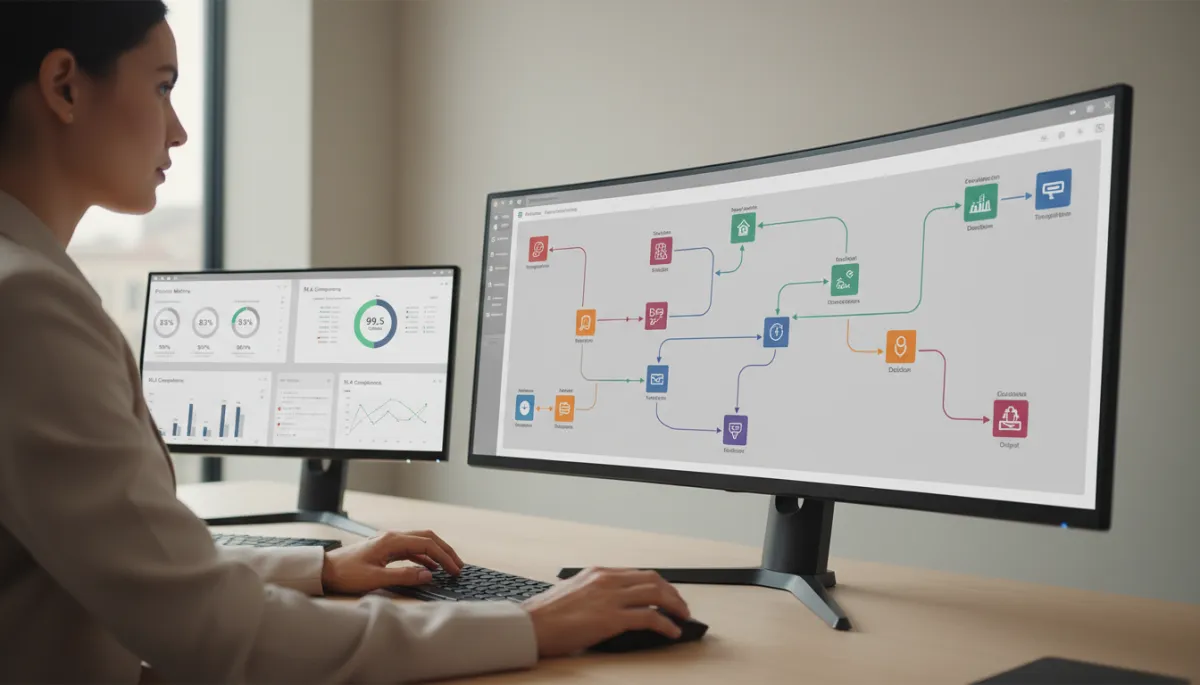
Visual workflow tools let domain experts drive automation, accelerating operational improvement.
4. Camunda – Enterprise Process Orchestration with BPMN and DMN
Camunda is a top‑tier orchestration engine for organizations that treat processes as long‑lived, mission‑critical assets. With full BPMN 2.0 and DMN support, it orchestrates human tasks, RPA bots, APIs, and microservices with high durability and observability (Automation Atlas; Gartner Peer Insights).
Best for: Enterprises needing standardized modeling, strong governance, and cross‑system orchestration spanning months‑long business processes.
Key efficiency lever: Creates a single source of truth for processes, improving transparency, compliance, and continuous optimization.
5. Temporal and Apache Airflow – Durable Orchestration for Technical Workflows
Temporal and Apache Airflow dominate developer‑centric orchestration. Temporal offers code‑first, durable workflows with multi‑language SDKs, ideal for complex, stateful backend processes. Airflow remains the standard for DAG‑based scheduling, data pipelines, and ETL automation, backed by a large open‑source community (Automation Atlas).
Best for: Engineering‑led organizations orchestrating data, microservices, and backend processes that demand reliability and retries at scale.
Key efficiency lever: Reduces operational toil and incident rates by codifying complex technical workflows with robust failure handling.
6. Wrk – Managed, Outcome‑Driven Hyperautomation
Wrk positions itself as a fully managed orchestration platform, combining AI, RPA, OCR, API connectors, and human‑in‑the‑loop tasks into pre‑built “workflows” delivered as a service (Wrk). It is particularly attractive for organizations that lack internal automation engineering capacity but still require enterprise‑grade compliance (SOC 2, HIPAA, PIPEDA).
Best for: Regulated industries and mid‑market firms seeking rapid, low‑friction automation with outcomes‑based pricing.
Key efficiency lever: Shortens deployment timelines by outsourcing orchestration design, monitoring, and maintenance to a specialist provider.
7. Appian (Agent Studio) – AI‑Augmented BPM for Regulated Workflows
Appian has evolved from low‑code BPM to a comprehensive automation platform with Agent Studio, enabling AI agents to operate within tightly governed processes (ITPro). The focus is on “serious AI” in unglamorous but critical processes—claims, underwriting, case management—where compliance and auditability are non‑negotiable.
Best for: Financial services, public sector, and other highly regulated domains needing AI‑augmented but tightly controlled workflows.
Key efficiency lever: Uses AI agents as co‑workers within BPM, accelerating decisions while preserving traceability and governance.
8. AuraQuantic and Pipefy – Structured BPA with Governance and Visibility
AuraQuantic and Pipefy emphasize structured process design, analytics, and governance. AuraQuantic delivers strong BPM capabilities with high visibility across multi‑step workflows (Moxo), while Pipefy is praised by peer reviews for low‑code process building, AI‑assisted agents, observability, and audit logs (Gartner Peer Insights).
Best for: Cross‑departmental process standardization—onboarding, procurement, service requests—where governance and transparency are key.
Key efficiency lever: Codifies repeatable processes into reusable templates, improving consistency, compliance, and time‑to‑deploy.
9. Blue Prism and Automation Anywhere – Proven RPA for Rule‑Based Tasks
Blue Prism and Automation Anywhere remain core RPA choices for organizations with large volumes of rule‑based, screen‑driven work. Blue Prism is often paired with separate orchestration layers, while Automation Anywhere increasingly integrates AI for document handling and decision support (Moxo; Automation Atlas).
Best for: Organizations with mature process documentation and high volumes of predictable, repetitive tasks across legacy systems.
Key efficiency lever: Drives significant cost and error reductions in back‑office operations when paired with strong process design and monitoring.
10. NewgenONE Intelligent Process Automation – AI‑First, Content‑Centric BPA
NewgenONE combines BPM, RPA, case and content management, rules, and contextual AI into a unified platform designed for content‑heavy industries (Gartner). It is particularly effective where documents, unstructured data, and complex cases dominate operational workloads.
Best for: Banking, insurance, and public sector organizations managing high volumes of content‑rich, case‑driven processes.
Key efficiency lever: Uses AI to classify, route, and act on content, accelerating end‑to‑end case resolution and reducing manual triage.
Emerging AI‑Native and Agentic Platforms: Preparing for the Next Wave
Beyond the top 10, a new class of AI‑native orchestrators is redefining what Business Process Automation means. Platforms such as Nexus, Duvo.ai, Moxo, and Flowable focus on agentic orchestration, where AI agents sense, reason, and act across workflows, often in judgment‑heavy or cross‑organizational scenarios (Agent Nexus; Moxo; Flowable).
Research indicates that 2026 is becoming AI’s “show‑me‑the‑money” year, with enterprises pushing agentic automation beyond pilots into scaled execution (Axios; TechRadar). When evaluating these platforms, prioritize governance, explainability, and operational controls as much as raw AI capability.
💡 Pro Tip: Start by embedding AI co‑pilots into existing BPM and BPA tools before moving to fully autonomous agents. This staged approach delivers efficiency gains while you mature governance and risk management practices.
Building a 2026‑Ready BPA Stack: From Technology to Operational Improvement
To translate technology into sustained operational improvement, design your BPA strategy along three layers:
Execution layer (RPA, APIs, agents): Tools such as UiPath, Blue Prism, Automation Anywhere, Zapier, and agentic platforms perform the actual work—clicking, reading, writing, and deciding within defined boundaries.
Orchestration and BPM layer: Platforms like Camunda, Temporal, Airflow, Appian, AuraQuantic, and Pipefy define process models, SLAs, escalations, and human‑in‑the‑loop controls, ensuring workflows remain coherent and auditable.
Governance and insight layer: Standardized frameworks, real‑time analytics, and process mining provide the transparency required to measure efficiency, detect anomalies, and iteratively improve operations (BOC Group; Zoho).
Critically, automation amplifies whatever process foundation exists. If your processes are inconsistent or undocumented, BPA will magnify that disorder (BOC Group). Invest in standardization and usability first; then layer in automation to unlock sustainable efficiency and operational excellence.
Conclusion: Turning 2026 BPA Tools into Measurable Business Value
The leading Business Process Automation tools of 2026—UiPath, Power Automate, Zapier, Camunda, Temporal, Wrk, Appian, AuraQuantic, Blue Prism, Automation Anywhere, NewgenONE, and emerging agentic platforms—provide a rich toolbox for transforming efficiency and operations. However, technology alone does not guarantee results. Organizations that win are those that:
Treat BPA as a strategic capability, not a collection of disconnected scripts or bots.
Align tool choices with process complexity, ecosystem, compliance posture, and internal skills.
Embed governance, observability, and continuous improvement into every automation initiative.
As agentic AI, hyperautomation, and AI‑augmented BPM mature, BPA will increasingly function as the operational nervous system of the enterprise. The decisions you make about tools and architecture in 2026 will define not only your efficiency profile, but also your organization’s ability to adapt, innovate, and compete in the years ahead.
